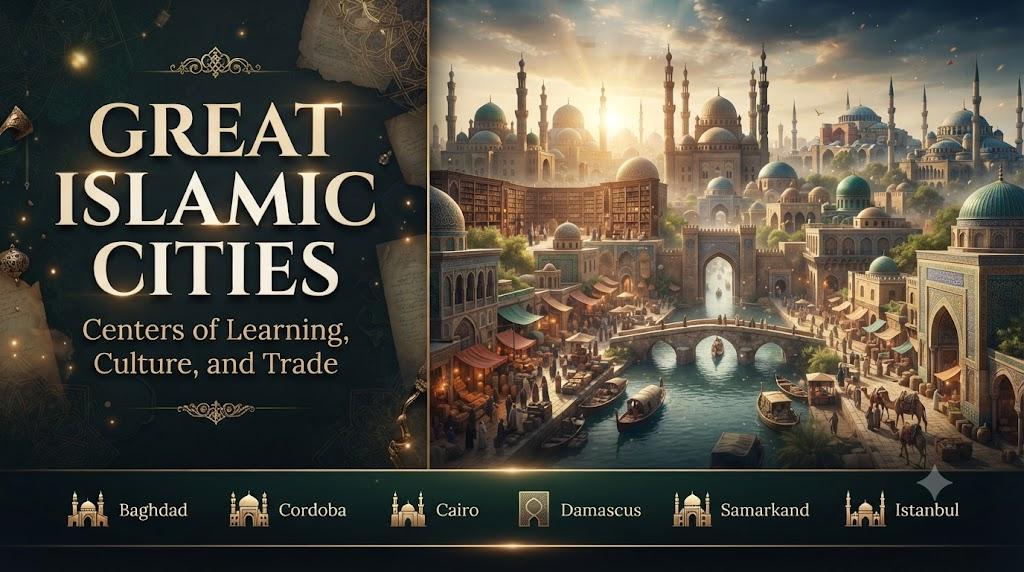
Throughout history, certain cities emerged as particularly significant centers of Islamic civilization—places where scholarship flourished, culture developed, commerce thrived, and governance innovated. These urban centers, spanning from Cordoba in the west to Samarqand in the east, shaped Islamic history while leaving architectural, intellectual, and cultural legacies enduring today. Exploring these cities illuminates geography of Islamic civilization’s achievements.
Baghdad, founded 762 CE by Caliph al-Mansur, became Abbasid capital and perhaps most celebrated Islamic city. Its Round City design symbolized cosmic order; its population swelled to million+ making it world’s largest metropolis. Bayt al-Hikma (House of Wisdom) attracted scholars globally; markets offered goods from everywhere; hospitals treated patients freely; public baths, parks, and libraries served citizens. Mongol destruction in 1258 CE ended golden era but city recovered partially, remaining important today as Iraq’s capital.
Cordoba in al-Andalus (Islamic Spain) represented western Islamic civilization’s height. Under Umayyad rule, Cordoba became Europe’s largest city with estimated 500,000 population, paved streets, street lighting (700 years before London), and 70 libraries including one holding 400,000 volumes. Great Mosque (Mezquita) remains architectural marvel blending Islamic design with later Christian modifications. Cordoba’s philosophers (Ibn Rushd, Maimonides), scientists, and poets influenced European Renaissance directly through translation movement and cross-cultural contact.
Cairo, founded 969 CE near existing Fustat, became Fatimid capital and subsequently Mamluk and Ottoman center. Al-Azhar University (established 972 CE) remains oldest continuously operating university, producing scholars influencing entire Muslim world. Cairo’s citadel, mosques (Sultan Hassan, al-Rifai), bazaars (Khan el-Khalili), and Nile location made it political, educational, and commercial hub. Today it’s Arab world’s largest city with over 20 million residents.
Constantinople/Istanbul’s conquest in 1453 CE by Ottoman Sultan Mehmed II marked epochal shift. City became Ottoman capital for nearly five centuries, receiving magnificent architectural additions: Hagia Sophia’s conversion to mosque, Süleymaniye Mosque complex, Topkapi Palace, and Grand Bazaar. Istanbul controlled trade routes between Europe and Asia, housing diverse populations of Turks, Greeks, Armenians, Jews, and others. Its strategic Bosporus location made it geopolitical prize coveted by empires.
Samarqand in Central Asia achieved prominence under Timurid rule in fourteenth-fifteenth centuries. Timur’s (Tamerlane’s) capital accumulated plunder from conquests, funding extraordinary architecture: Registan Square’s madrasas, Bibi Khanum Mosque, Gur-e-Amir mausoleum. Ulugh Beg’s observatory produced astronomical tables unsurpassed for three centuries. Samarqand sat on Silk Road connecting China and Mediterranean, facilitating exchange of goods, ideas, and technologies.
Isfahan reached zenith under Safavid Shah Abbas I (1587-1629 CE). Naqsh-e Jahan Square (Imam Square today) surrounded by majestic buildings: Sheikh Lotfollah Mosque, Imam Mosque, Ali Qapu Palace, and Qeysarieh Bazaar. Persian gardens, bridges (Khaju, Si-o-se Pol), and palaces displayed aesthetic sophistication. Isfahan’s carpet weaving, miniature painting, and calligraphy set artistic standards. Persian proverb “Isfahan nesf-e jahan” (Isfahan is half the world) captured its magnificence.
Granada represented final flourish of Islamic Spain before 1492 expulsion. Alhambra Palace complex remains Islamic architecture’s crowning achievement—geometric patterns, arabesque designs, courtyard gardens, and inscribed poetry create unparalleled beauty expressing Islamic aesthetic ideals. Generalife gardens demonstrated sophisticated water engineering and landscape design. Granada’s fall ended nearly eight centuries of Muslim presence in Iberia, but Alhambra endures as testament to achieved civilization.
Jerusalem holds special status as third holiest city in Islam and first qibla direction. Dome of Rock (Qubbat al-Sakhra) and Al-Aqsa Mosque occupy Temple Mount/Haram al-Sharif, visited by pilgrims throughout Islamic history. City’s sacred geography connects to Prophetic Night Journey (Isra) and gathering place for Resurrection. Political complexities surrounding Jerusalem reflect its ongoing religious significance for Muslims, Christians, and Jews.
Damascus among oldest continuously inhabited cities, became Umayyad capital (661-750 CE) before Abbasid shift to Baghdad. Umayyad Mosque remains one of Islam’s largest and most beautiful, built on site of Christian basilica (itself on Roman temple). Damascus’s souqs (especially Al-Hamidiyah), traditional houses, and location at oasis edge of desert made it important trading and scholarly center. It remains Syria’s capital despite recent devastating conflict.
These cities shared characteristics enabling their prominence: strategic locations facilitating trade, political patronage supporting institutions, religious diversity stimulating intellectual exchange, architectural expression demonstrating communal identity, and market economies generating prosperity. They also faced common challenges: conquest and destruction, plague and famine, political instability, and eventual decline relative to rising centers elsewhere.
Urban planning principles derived from these cities include: mosque as central organizing structure, suq (market) adjacent to religious space, residential neighborhoods (hara) forming organic patterns around courtyards, defensive walls defining urban boundaries, and water management systems (qanats, cisterns, channels) sustaining large populations. These elements influenced urban form across Islamic world.
Contemporary Muslim-majority cities (Jakarta, Karachi, Dhaka, Lagos) now dwarf historical centers in population but often struggle to achieve comparable cultural/intellectual density. Modern challenges—infrastructure strain, pollution, inequality, identity politics—differ from pre-modern concerns yet require equally creative solutions. Learning from historical cities’ successes and failures informs contemporary urban development in Muslim contexts.
Visiting these cities today (where possible and safe) connects physically with Islamic heritage. Walking Cordoba’s Jewish Quarter, praying in Cairo’s Al-Azhar, viewing Istanbul’s skyline from Galata Bridge, or wandering Isfahan’s Naqsh-e Jahan Square creates experiential connection surpassing textual study alone. For those unable to visit, virtual tours, photographic documentation, and literary descriptions provide alternative access to these treasures.
These cities remind us that Islamic civilization produced urban environments of remarkable sophistication—centers where learning flourished, beauty was created, commerce thrived, and diverse peoples coexisted productively. This heritage belongs to all humanity while holding particular meaning for Muslims as demonstration of what faith-inspired civilization can achieve.