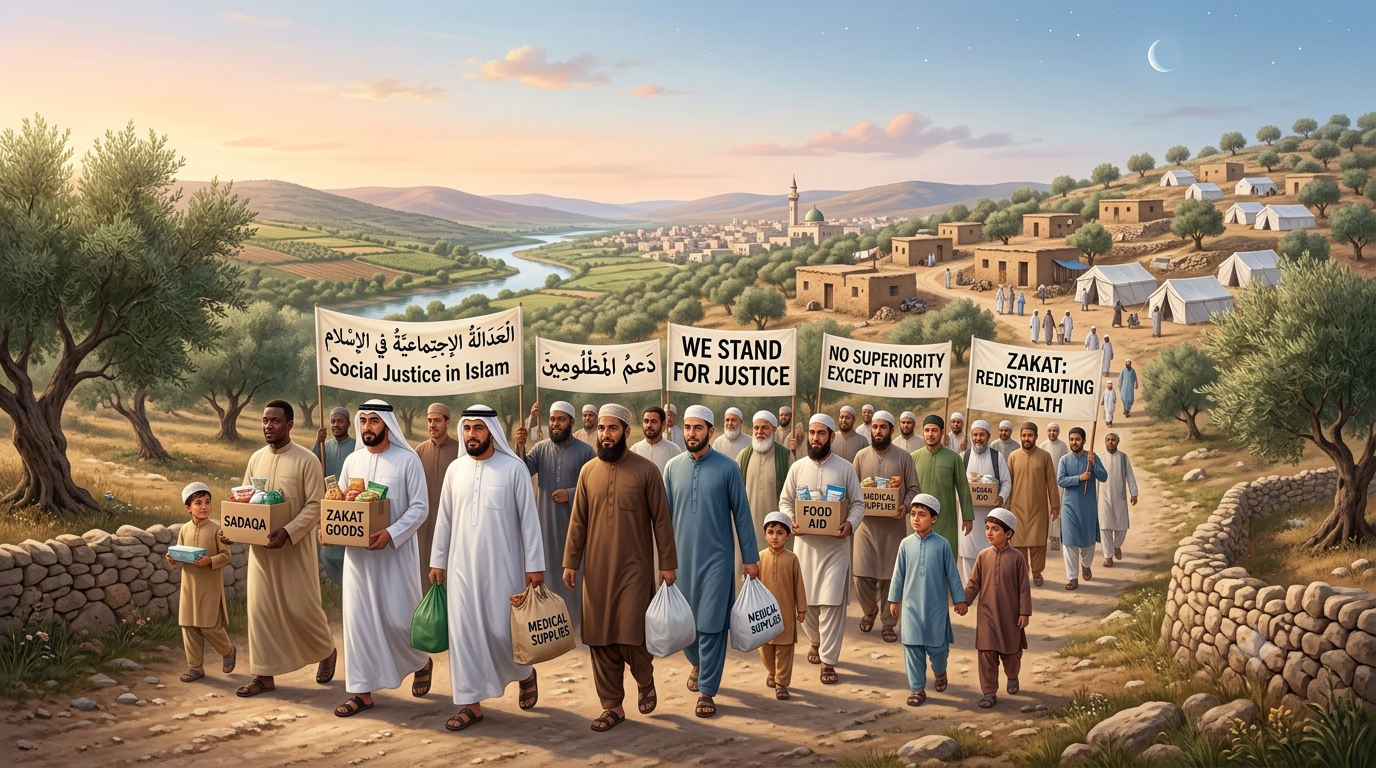
Social justice stands at the heart of Islamic message—from Quran’s emphatic commands to stand for justice even against oneself, to the Prophet’s practical establishment of radically egalitarian community in seventh-century Arabia. This commitment to justice encompasses economic equity, racial equality, gender fairness, protection of vulnerable populations, and resistance to oppression in all its forms. Understanding and applying these teachings empowers Muslims to contribute meaningfully to contemporary struggles for more just societies. Economic justice receives extensive Quranic attention. Zakat (obligatory charity) functions as wealth redistribution mechanism—2.5% of accumulated assets annually transferred from wealthy to specified categories including poor, needy, debtors, and travelers in difficulty. This is not voluntary generosity but religious obligation (pillar of Islam) with enforcement mechanisms in properly functioning Islamic state. Beyond zakat, sadaqa (voluntary charity) is constantly encouraged, with rewards multiplied many times for givers. Prohibition of riba (interest/usury) addresses structural exploitation built into financial systems favoring capital over labor. Inheritance rules guarantee shares to multiple family members, preventing disinheritance patterns concentrating wealth. Collectively, these teachings establish economic framework prioritizing human need over accumulation.
Racial and ethnic equality was revolutionary in Prophet’s message. Final sermon’s declaration—”;An Arab has no superiority over a non-Arab nor a non-Arab has any superiority over an Arab…except in piety”;—directly challenged entrenched tribal prejudices. The Prophet’s companions included Bilal the Ethiopian former slave (chosen as first muazzin to call prayer), Suhayb the Roman, Salman the Persian—demonstrating Islam’s transnational, multiethnic character from inception. Contemporary racism among Muslims contradicts this foundational example, whatever cultural or historical factors enable its persistence. Gender justice in Islamic framework recognizes different but complementary roles while ensuring fundamental equality of worth, spiritual status, and human dignity. Women’s rights to property ownership, inheritance, education, contract participation, and choice in marriage represented enormous advancement over pre-Islamic Arabian patriarchy. Contemporary debates about specific applications continue—interpretations vary regarding leadership positions, dress requirements, testimony weight, and other contested areas. What remains uncontroversial is Islam’s opposition to female infanticide (practiced before Islam), forced marriage, and denial of women’s full humanity. Protection of vulnerable populations appears consistently throughout Quran and hadith. Orphans receive specific mention with stern warnings against misappropriating their property. Rights of poor, wayfarer, and beggar appear alongside orphan rights in same verses (9:60, 60:11). Slaves were granted rights unprecedented for their era—eventual emancipation encouraged through multiple channels, mistreatment strictly prohibited, marriage and family formation supported. Contemporary vulnerable populations—refugees, minorities, disabled persons, elderly isolated from family—fall under same protective umbrella that Islam extends to all who cannot fully protect themselves. Speaking truth to power represents Islamic imperative. The Prophet modeled criticism of powerful—addressing rulers of his time (including those who persecuted him) with unwavering commitment to truth. Companion Abu Dharr al-Ghifari famously criticized Uthman’s wealth distribution publicly, resulting in exile but also reverence as exemplar of courageous honesty. Enjoining good and forbidding evil (amr bil ma’ruf wa nahi anil munkar) constitutes communal obligation with implications for social activism. Silence in face of injustice constitutes complicity according to numerous prophetic teachings. Prisoner rights, torture prohibition, and due process have Islamic foundations. Rules of engagement in warfare strictly protect non-combatants, property, environment, and even enemy prisoners who must be treated humanely. These principles, articulated centuries before Geneva Conventions, establish precedent for humanitarian law from Islamic perspective. Contemporary application includes advocacy against torture, indefinite detention, extrajudicial killing, and military practices causing disproportionate civilian harm. Environmental justice connects to Islamic environmental teachings previously discussed. Pollution disproportionately affecting poor communities, climate change impacting developing nations most severely, resource extraction devastating indigenous lands—these patterns of environmental injustice violate Islamic principles of harm prevention, public interest, and protection of vulnerable. Muslim environmental activists draw upon religious teachings to advocate for policies protecting both planet and its most vulnerable inhabitants. Practical engagement takes multiple forms. Direct service—running food pantries, homeless shelters, free clinics, refugee assistance programs—fulfills immediate needs while building relationships across difference. Policy advocacy shapes systemic solutions through legislation, regulation, and institutional reform. Community organizing builds power among affected populations. Education and awareness raise consciousness about injustice and potential responses. Financial support sustains organizations doing frontline work. Each mode of engagement suits different temperaments, abilities, and circumstances. Challenges and complexities abound. Prioritizing among infinite worthy causes requires wisdom.
Working across difference with those of other faiths or no faith raises questions about alliance and compromise. Burnout threatens those deeply engaged in difficult work. Government surveillance and repression may target activists. Internal community dynamics may resist change or criticize methods. None of these challenges invalidates the obligation—they simply require thoughtful navigation. The spiritual dimension sustains long-term commitment. Justice work grounded primarily in anger or ideology eventually exhausts. Justice work grounded in love of Allah, desire for His pleasure, trust in His ultimate justice, and hope for His reward endures through difficulties. Prayer maintains connection to Source of strength. Community provides mutual support. Remembrance (dhikr) reorients hearts toward eternal perspective amid temporal struggles. Social justice in Islamic framework is ultimately act of worship—serving Allah through serving His creation, particularly those most in need of service.