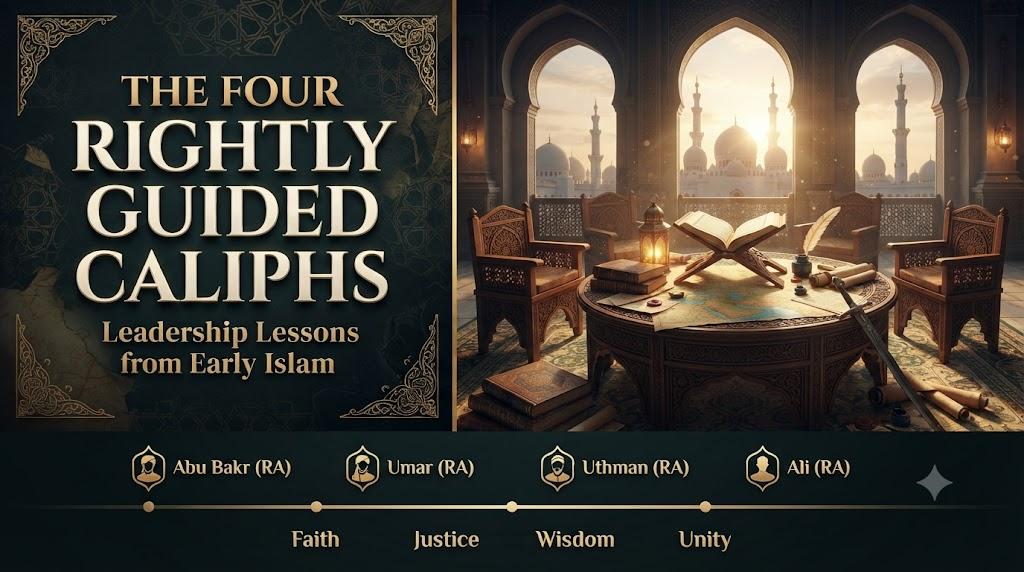
The Rashidun Caliphate (632-661 CE), spanning rule of four successors to Prophet Muhammad—Abu Bakr, Umar, Uthman, and Ali—represents idealized period of Islamic governance often referenced as model for just leadership. While historical realities complicate simple narratives, studying these caliphs’ approaches to power, policy, and personal conduct yields valuable lessons for contemporary Muslims interested in Islamic governance and leadership principles.
Abu Bakr as-Siddiq (r. 632-634 CE) faced immediate crisis upon assuming leadership: apostasy (ridda) movements threatening to dissolve unified Arabian peninsula. His response combined military firmness with diplomatic flexibility—welcoming back rebels who repented while defeating those persisting in rebellion. This balance of principle and pragmatism stabilized community when survival seemed uncertain. His personal humility (continuing merchant work initially, refusing salary beyond basic needs) modeled servant leadership.
Umar ibn al-Khattab (r. 634-644 CE) transformed embryonic state into empire while establishing administrative innovations enduring centuries. Diwan system organized state finances and military pay. Judicial reforms standardized legal procedures. Municipal services (police, street lighting, building inspection) improved urban life. His famous nighttime patrols—disguised commoner checking subjects’ welfare personally—exemplified hands-on leadership. Economic policies prevented concentration of wealth while funding public goods.
Uthman ibn Affan (r. 644-656 CE) is remembered primarily for compiling definitive Quran text—a contribution whose value cannot be overstated. Previous written versions varied in dialectal pronunciation and verse ordering; Uthman’s standardization preserved revelation accurately for all time. His expansive conquests brought wealth some felt was distributed unfairly; his clan-based appointments favored Umayyads over other groups. These grievances eventually led to assassination—tragedy revealing dangers of perceived favoritism even if intentions were pure.
Ali ibn Abi Talib (r. 656-661 CE) assumed leadership amid turmoil following Uthman’s murder. His caliphate faced immediate civil war (Fitna): Battle of the Camel against Aisha and companions seeking Uthman’s killers’ punishment; Battle of Siffin against Muawiya demanding similar justice; arbitration attempt that alienated some supporters. His martyrdom ended Rashidun period, initiating Umayyad dynastic rule. His reign demonstrates how even righteous leaders face constraints limiting ideal implementation.
Leadership principles emerging from this period include: consultation (shura) in decision-making (all four caliphs consulted companions); accountability before Allah and community (Abu Bakr’s address acknowledging potential errors); justice regardless of social status (Umar’s son held to same laws as commoners); accessibility to subjects (open door policies allowing direct petitioning); and prioritizing collective good over personal interest (Uthman’s wealth used for community benefit).
Administrative innovations established templates for Islamic governance. Provincial governors (wali) reported to central authority with oversight mechanisms. Treasury (bayt al-mal) managed public funds transparently. Judge (qadi) positions operated independently from executive power. Welfare systems supported poor, disabled, elderly, and travelers. Military organization distinguished between regular forces and tribal auxiliaries. These structures influenced subsequent Islamic polities significantly.
Economic policies reflected Islamic principles. Land tax (kharaj) applied fairly to conquered territories; zakah funded social welfare; trade flourished under consistent regulations; currency reform (Umar introducing standardized dinar/dirham) facilitated commerce. Prohibition of riba (interest) guided financial transactions. These policies created prosperous economy benefiting broad population segments.
Challenges and limitations should be acknowledged honestly. Women’s formal political participation remained limited despite their significant informal influence. Slavery wasn’t abolished immediately though its conditions improved. Tribal tensions persisted beneath Islamic unity surface. Expansion involved warfare causing suffering despite relatively humane rules of engagement. Perfection belonged only to Allah; human efforts—even righteous ones—carried flaws alongside achievements.
Historical debates about succession (Ali’s right versus companion consensus choosing first three caliphs) generated Sunni-Shia division persisting today. Understanding multiple perspectives without necessarily resolving them enables respectful disagreement among Muslims. The Rashidun period offers shared heritage regardless of sectarian interpretation—model of committed leadership striving toward Islamic ideals.
Contemporary applications draw inspiration from Rashidun principles. Anti-corruption efforts reference Umar’s accountability measures. Welfare state concepts trace to Rashidun social policies. Constitutional governance finds precedent in Madinah document and early caliphal practices. Environmental protection recalls Umar’s instruction not to harm trees unnecessarily. These connections demonstrate continuing relevance.
Studying this period requires avoiding both romanticization (ignoring problems) and cynicism (dismissal as power struggle). Balanced assessment recognizes genuine achievements while acknowledging human limitations. The caliphs were sincere Muslims doing their best in unprecedented circumstances—their successes inspire; their failures instruct.
The ultimate lesson may be that righteous leadership, while never perfect, creates conditions for societal flourishing impossible under corrupt or incompetent rule. The Rashidun period’s relative brevity (29 years) produced changes resonating 1,400 years later. Quality of leadership matters profoundly—and Muslims remain responsible for cultivating, supporting, and becoming such leaders in their own contexts.