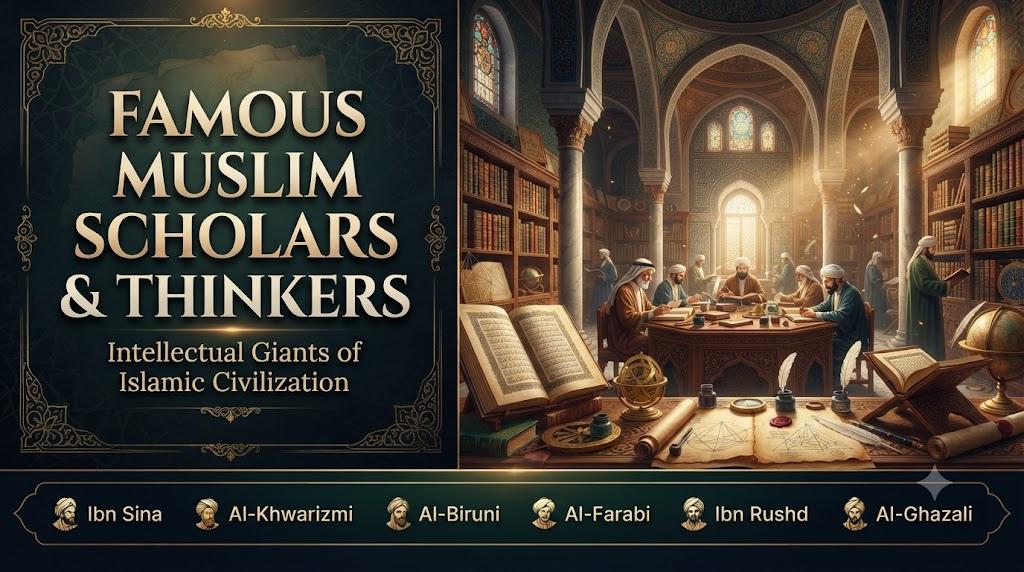
Islamic civilization produced numerous scholars whose contributions shaped not only Muslim world but human knowledge generally. These intellectuals excelled across disciplines—theology, law, philosophy, science, medicine, mathematics, and more—often achieving polymathic breadth rare in specialized modern academy. Studying their lives and works inspires contemporary Muslims while correcting historical narratives marginalizing Islamic intellectual heritage.
Al-Khwarizmi (c. 780-850 CE), Persian mathematician and astronomer, gave us “algorithm” (from his name) and “algebra” (from his book Kitab al-Jabr). His work systematized equation-solving methods previously scattered and intuitive. He also contributed to astronomy, geography (improving Ptolemy’s Geography), and calendar systems. His works translated into Latin in twelfth century became standard European mathematics texts for centuries—directly influencing development of Western science.
Ibn Sina (Avicenna, 980-1037 CE), perhaps most influential Muslim philosopher, authored over 450 works across multiple fields. His Canon of Medicine (al-Qanun fi al-Tibb) systematized medical knowledge so effectively that it served as primary European medical textbook into seventeenth century. His philosophical synthesis (al-Shifa’) integrated Aristotelian logic with Islamic theology, influencing both Islamic philosophy (kalam) and medieval Scholasticism through Latin translations. His range spanned physics, psychology, geology, mathematics, and poetry—true polymath.
Ibn al-Haytham (Alhazen, 965-1040 CE), father of modern optics, revolutionized understanding of vision through experimental method. His Book of Optics overturned Greek emission theory (that eyes emit rays) proving intromission theory (eyes receive light rays) through carefully designed experiments using camera obscura. His emphasis on hypothesis, experimentation, and induction prefigured scientific method. Beyond optics, he contributed to astronomy, mathematics, and philosophy of science.
Al-Ghazali (1058-1111 CE), theologian and mystic, addressed crisis of confidence in rational philosophy through landmark work Incoherence of Philosophers (Tahafut al-Falasifa). While critiquing philosophers who prioritized reason over revelation, he ultimately integrated useful philosophical methods into Islamic theology. His autobiography Deliverance from Error describes intellectual and spiritual journey influencing countless seekers. Revival of Religious Sciences (Ihya Ulum al-Din) remains widely read manual of Islamic spirituality and ethics.
Ibn Rushd (Averroes, 1126-1198 CE), Andalusian philosopher and jurist, wrote extensive commentaries on Aristotle recovering much Greek thought for Latin West. His influential (and controversial) theory of double truth attempted harmonizing philosophy and religion—arguing they reach same truths through different means. His medical works were authoritative; his juridical writings influenced Islamic legal thought. Latin Averroism significantly impacted European scholasticism.
Ibn Khaldun (1332-1406 CE), historian and sociologist, pioneered philosophy of history and social science through Muqaddimah (Prolegomena). His cyclical theory of civilization’s rise and fall (asabiyyah—social cohesion—as explanatory concept) anticipated modern sociology and historiography. He analyzed how geography, economics, social structure, and religion interact to shape historical development—frameworks still relevant for analyzing contemporary societies.
Rumi (1207-1273 CE), Persian poet and Sufi mystic, produced Masnavi-ye-Ma’navi (Spiritual Couplets)—six volumes of poetry considered “Persian Quran” by some. His whirling dervishes (Mevlevi order) express ecstatic devotion through movement. His poetry emphasizes divine love, unity of being (wahdat al-wujud), and spiritual transformation through love’s refining fire. His influence extends far beyond Muslim world to global spiritual seekers.
Fatima al-Fihriya (c. 800-880 CE), founder of University of Al-Qarawiyyin in Fez (Morocco), established world’s oldest continuously operating university through waqf (endowment) funding. Using her inheritance to build mosque that became educational center, she enabled centuries of scholarship producing countless jurists, scientists, and thinkers. Her philanthropic vision demonstrates women’s role in Islamic institutional development.
Maryam al-Ijliya al-Astrulabi (tenth century CE), astronomer in Aleppo, worked as astrolabe maker—unusual profession for woman in any historical period. Apprenticed to her father (also instrument maker), she gained such expertise that she was employed by ruler Sayf al-Dawla. Her story demonstrates women’s participation in scientific work during Islamic Golden Age, challenging assumptions about gender restrictions on intellectual activity.
Studying these scholars reveals patterns: rigorous training from childhood, mastery of multiple disciplines, integration of faith and reason, commitment to teaching and transmission, and often difficult personal circumstances overcome through perseverance. They weren’t isolated geniuses but products of educational systems and cultural values supporting intellectual pursuit.
Their influence extended far beyond individual lifetimes through student networks, written works copied and studied across centuries, and ideas absorbed into later thought systems (including modern science). When Europeans rediscovered Aristotle, they often read Ibn Rushd’s commentaries. When physicians studied anatomy, they used Ibn Sina’s descriptions. When mathematicians solved equations, they used al-Khwarizmi’s methods. Islamic scholarship formed essential bridge between ancient and modern knowledge.
Contemporary Muslims can draw inspiration from these predecessors’ examples. Pursuing excellence in chosen field, integrating faith with professional work, contributing knowledge benefiting humanity, mentoring next generation, and persevering through difficulties—all find models in these historical figures. Their achievements prove Islam’s compatibility with highest levels of intellectual accomplishment.
The tradition continues today through Muslim scientists, scholars, and thinkers working globally. Names like Abdus Salam (physics Nobel laureate), Fazlur Khan (structural engineer), and countless others extend lineage of Muslim intellectual contribution. Honoring predecessors while supporting current practitioners sustains civilization’s ongoing development.