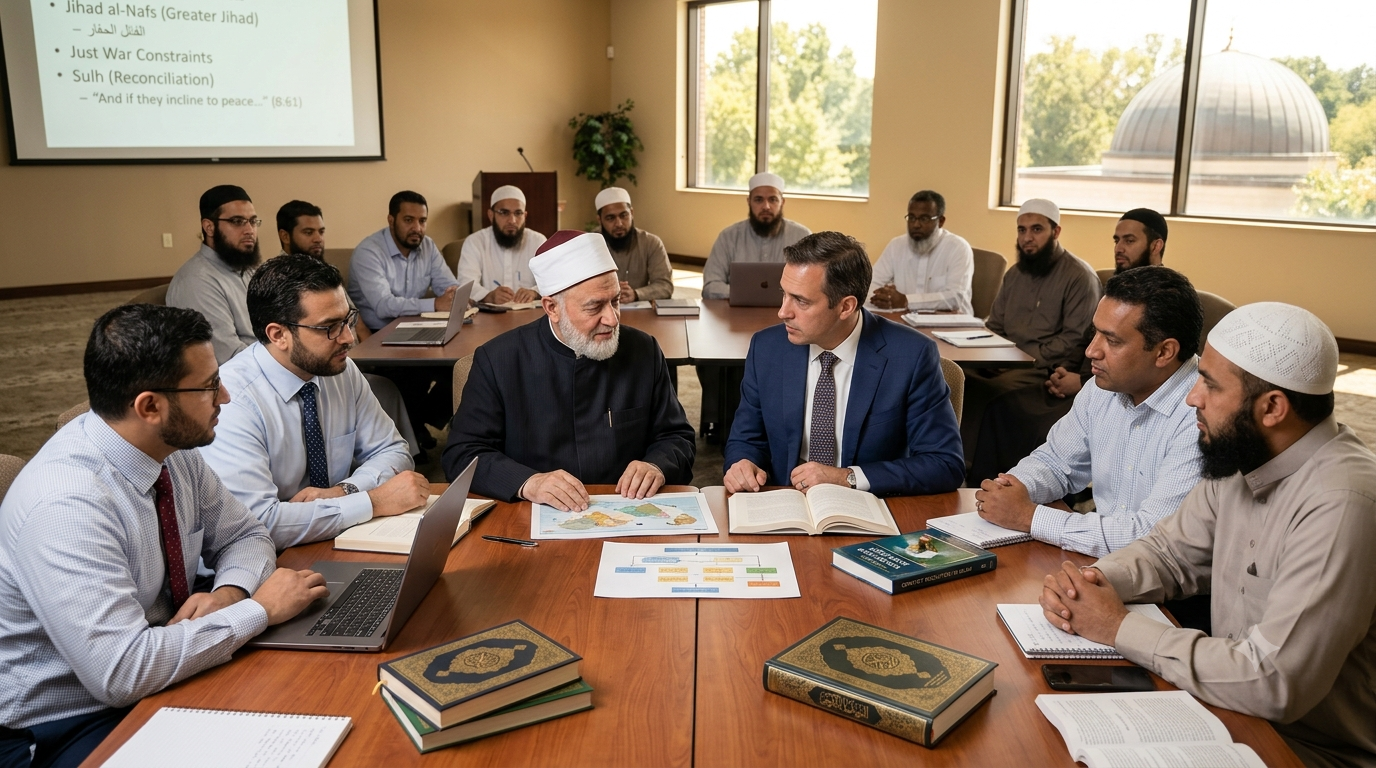
Warfare occupies significant space in Islamic texts, history, and contemporary discourse—yet Islam’s actual teachings on legitimate use of force, constraints on violence, and pathways to peace remain poorly understood even by many Muslims, let alone by external observers. Developing coherent Islamic framework for thinking about war and peace proves essential for engaging contemporary conflicts responsibly while maintaining fidelity to authentic sources. This framework must address when fighting is permissible, how it must be conducted, how it should end, and how to prevent recurrence. The concept of jihad represents Islam’s most discussed (and most misunderstood) term related to warfare. Linguistically meaning “;striving”; or “;exertion,”; jihad encompasses spiritual struggle against base desires (greater jihad, per a famous though disputed hadith), verbal advocacy for truth, communal self-defense, and under specific circumstances, armed combat against aggression. Reducing jihad exclusively to “;holy war”; (a term never appearing in Islamic primary sources) fundamentally distorts concept. Armed jihad specifically requires legitimate authority (state permission, not individual initiative), defensive purpose (responding to attack or protecting vulnerable), proportional means, and non-combatant protection—conditions frequently violated by groups claiming Islamic justification for indiscriminate violence. Classical Islamic jurisprudence developed detailed rules of engagement that anticipate modern international humanitarian law by centuries. Prohibited tactics include killing women, children, elderly, and non-combatants (unless directly participating in hostilities); destroying crops, livestock, or infrastructure essential for civilian survival; mutilation of bodies; perfidy (feigning surrender or protected status to launch attacks); and targeting religious personnel or sites of other faiths. Positive obligations include offering
terms before initiating battle (calling to Islam or accepting submission/treaty), proper treatment of prisoners (feeding, clothing, sheltering according to captor’s own standard), honoring agreements (even with enemies), and avoiding excess (ghuluw) in any direction. These rules derived from explicit Quranic verses, numerous prophetic hadiths, and companion practices—representing binding religious obligation, not mere strategic preference. The question of legitimate authority for declaring armed jihad generates significant contemporary debate. Classical scholars generally held that only recognized political authority (caliph or delegated ruler) could authorize offensive military action. Defensive jihad (repelling immediate attack) permitted broader initiation including local resistance when central authority absent or ineffective. Modern contexts where caliphate doesn’t exist create ambiguity: who possesses authority to authorize force? State governments? Scholarly consensus? Popular movements? Extremist groups claim authority rejected by mainstream scholars. This contested terrain requires careful navigation—neither legitimating every group bearing Islamic banner nor denying legitimate resistance rights to occupied peoples. Peace (sulh) in Islamic tradition carries active rather than passive connotation. Islam prefers peace to fighting when possible: “;And if they incline to peace, then incline to it [also] and rely upon Allah”; (8:61). Making peace even at potential cost to Muslim interests merits consideration when genuine peace offer exists. The Treaty of Hudaybiyyah exemplifies this principle: Prophet Muhammad accepted apparently unfavorable terms (returning Meccan converts seeking refuge, delaying pilgrimage) that ultimately enabled Muslim community’s growth and Mecca’s eventual peaceful opening. Strategic patience in pursuit of long-term peace outweighs short-term military advantage. Reconciliation (musalaha) after conflict requires addressing grievances fueling violence. Islamic emphasis on justice (‘adl) as prerequisite for sustainable peace distinguishes mere cessation of hostilities (which may be temporary) from genuine reconciliation addressing root causes. Forgiveness (‘afw) is encouraged but not required of victims; justice and mercy must balance. Restoration of rights (haqq) owed to wronged parties forms necessary component of lasting peace. Mediation (wasata/wasatah) holds respected place in Islamic conflict resolution tradition. Accepting mediator’s role (even from neutral party) demonstrates wisdom over pride. The Prophet himself mediated tribal disputes before prophethood; early Muslim community utilized mediation extensively. Contemporary Muslim mediation networks operate in various conflicts, though systematic professionalization lags behind secular alternatives. Building mediation capacity within Muslim civil society represents underexplored opportunity. Post-conflict reconstruction from Islamic perspective extends beyond physical rebuilding to social healing. ‘Afww (pardon) facilitates societal reintegration of former combatants. Muhajara (abandonment) practices allow temporary separation cooling tensions. Financial compensation (diyah) addresses material harm in cases of unintentional killing or injury according to detailed classical schedules. Restorative justice elements in Islamic law prioritize victim-community restoration alongside offender accountability—approaches gaining traction in secular circles but already present in Islamic tradition. Preventive diplomacy draws upon Islamic concepts of hisba (enjoining good/forbidding evil) and nasiha (sincere advice). Early intervention in escalating disputes, building relationships before conflicts arise, addressing grievances before they fester into violence—all align with prophetic emphasis on preventing harm rather than merely responding after damage occurs. Muslim communities’ investment in preventive measures (interfaith dialogue, youth programming, economic development, conflict sensitivity training) remains insufficient relative to need. Nuclear weapons and weapons of mass destruction raise questions classical jurists never imagined. Most contemporary scholars prohibit WMD development or use based on proportional
destruction (indiscriminate killing of combatants and non-combatants), environmental harm (destroying creations of Allah excessively), and uncertainty about long-term consequences. A small minority argues deterrence justification using lesser-of-two-evils reasoning. The ethical questions intensify regarding Muslim-majority states possessing or seeking such weapons (Pakistan confirmed nuclear; Iran’s program controversial; allegations about others). Civil society discourse within Muslim world about these issues remains underdeveloped compared to technical discussion. Nonviolent resistance has Islamic foundations often overlooked. The Prophet’s response to persecution in Mecca (enduring without violent retaliation for thirteen years), later Muslim examples of conscientious objection, and classical concepts of sabr (patient perseverance) and resistance through moral means provide resources for nonviolent campaigns. Contemporary Muslim nonviolent movements (various independence struggles, civil rights activism) demonstrate applicability, though systematic Islamic theology of nonviolence needs further development. Ultimately, Islamic approach to war and peace balances realism about human conflict potential with idealism about divine guidance for minimizing harm and pursuing justice. Neither pacifist (force sometimes necessary) nor militarist (force always last resort, heavily constrained), Islamic framework offers resources for contemporary peacebuilding that deserve greater development, application, and testing in actual conflict settings. Muslims committed to these principles must advocate for them within own communities, demonstrate their viability through practice, and contribute to broader global discourse about achieving just and lasting peace.