
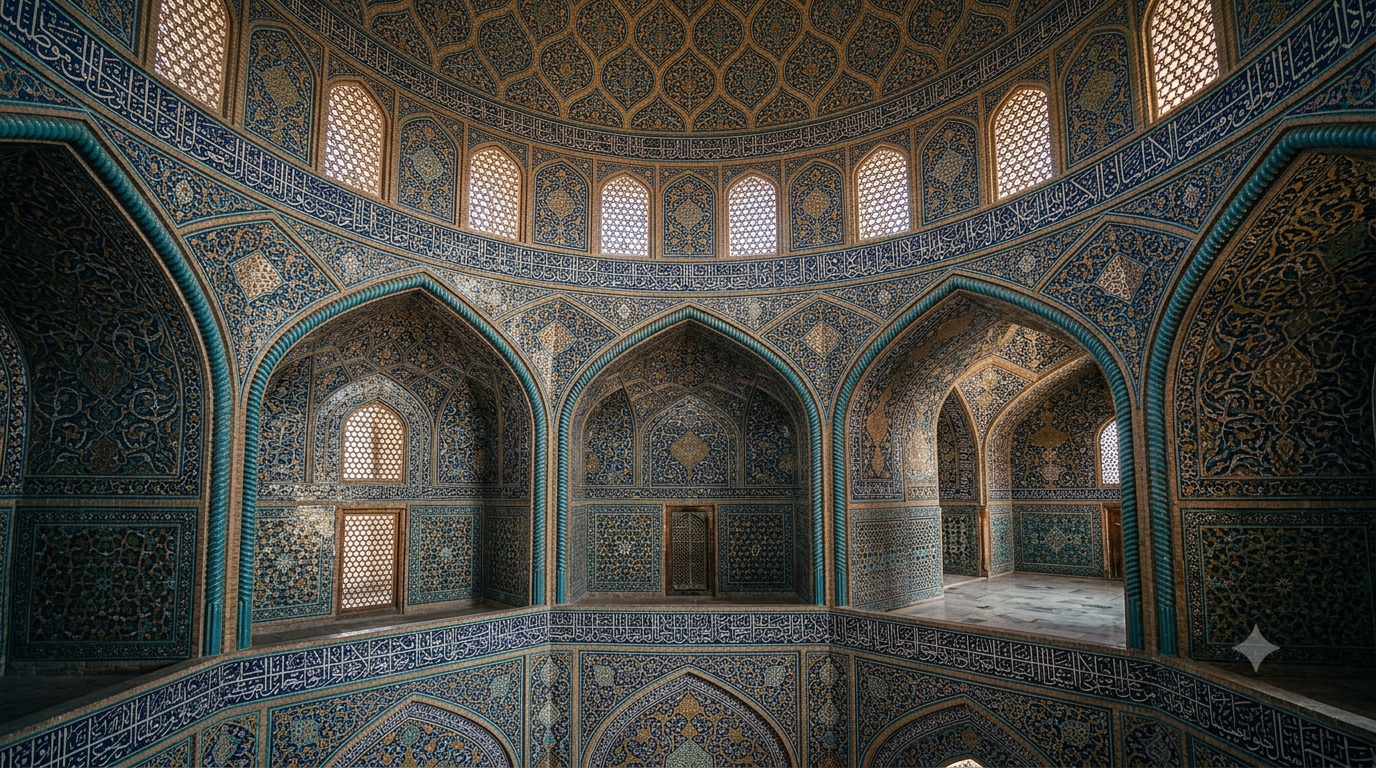
Aniconism—the absence or minimization of figurative imagery—represents distinguishing characteristic of much traditional Islamic art, particularly in religious contexts. While not absolute prohibition across all times and places (figurative illustration flourished in manuscript painting and some decorative arts), strong preference for non-figurative expression shaped Islamic aesthetic development uniquely. Understanding aniconism’s theological roots, historical manifestations, and contemporary implications illuminates Islamic art’s distinctive character.
Quranic foundations address image-making ambiguously but significantly. Verses criticizing idol-worshippers who carve statues (Sad: 95-96, An’am: 74) associate figurative representation with polytheistic practice Islam rejected. However, no verse explicitly prohibits all images categorically. The primary concern appears association with shirk (associating partners with Allah) rather than representation per se—images become problematic when venerated or worshiped, not merely because they depict living beings.
Hadith literature contains stronger prohibitions with varying authentication levels. Narrations report the Prophet commanding removal of pictures from homes, warning that angels don’t enter houses containing dogs or pictures, and stating that image-makers will face severest punishment on Judgment Day (required to breathe soul into creations they cannot animate). Other hadiths permit images that aren’t worshipped (rugs, cushions) or distinguish between respectful treatment and abuse. Scholars differ on which prohibitions are binding versus context-specific.
Classical juristic debate produced nuanced positions. Majority view (Maliki, Shafi’i, Hanbali) prohibits creating images of sentient beings absolutely—whether for worship or decoration—based on strong hadith evidence. Hanafi position permits images if not displayed respectfully or potentially venerated. Some scholars distinguished two-dimensional representations (more acceptable) from three-dimensional sculpture (more prohibited). Context mattered: mosque decoration faced stricter limits than private homes; public art faced different rules than personal items.
Practical consequences directed artistic energy toward alternative expressions. Calligraphy replaced figural representation as preeminent sacred art. Geometric patterns offered mathematically sophisticated non-figural alternatives. Arabesque (vegetal patterns) provided organic decoration without depicting complete organisms. Architectural ornamentation focused on surface treatment rather than sculptural representation. These alternatives became highly developed precisely because figurative option was constrained—necessity mothering invention.
Exceptions and variations complicate any simple narrative. Persian miniature painting (13th-16th centuries) depicted human figures extensively in manuscript illustration—particularly for epics like Shahnameh and historical chronicles. Mughal portraiture flourished under royal patronage. Ottoman harem paintings documented
court life. These exceptions typically occurred in secular contexts (books, palaces) rather than religious spaces (mosques, madrasas), suggesting contextual sensitivity rather than absolute rule.
Theological reasoning behind aniconism connects to several concerns. Creator jealousy: only Allah can create living beings; human attempts at creation usurp divine prerogative. Distraction risk: figures draw attention away from divine remembrance toward creaturely beauty. Idolatry prevention: even initially innocent images may eventually receive veneration (historical trajectory of Christian iconography cited as cautionary example). Spiritual purity: abstract forms better suit transcendent deity beyond physical representation. These arguments carry varying weight across scholarly traditions.
Comparative perspective situates Islamic aniconism among broader religious attitudes toward images. Judaism’s Second Commandment prohibition influenced Islamic thinking directly. Byzantine iconoclasm controversy (8th-9th centuries) paralleled Islamic debates. Hindu darshan tradition takes opposite approach, welcoming divine images as manifestation sites. Protestant iconoclasm echoed Islamic concerns about idolatry. No religion holds uniform position across all adherents; internal diversity characterizes each tradition’s image theology.
Contemporary Muslim attitudes range widely. Strict traditionalists avoid all figurative art, including photographs. Moderate conservatives accept photography (mechanically reproduced, not artistically created) while avoiding drawn/painted figures. Liberal Muslims see no problem with any art form. Artists working in Islamic contexts navigate these sensitivities—some focusing exclusively on calligraphy and abstraction, others incorporating figurative elements cautiously, others ignoring restrictions entirely based on personal interpretation.
Digital age raises new questions. Is screen image equivalent to physical picture? Does photography’s mechanical nature exempt it from prohibition? What about AI-generated images? Video games with avatars? Social media profile pictures? Classical rulings don’t directly address technologies unimaginable to earlier scholars. Contemporary jurisprudence applies analogical reasoning (qiyas) and public interest consideration (maslaha) to novel situations—with varying conclusions.
Appreciating Islamic non-figurative art requires shifting expectations trained on Western figurative tradition. Instead of asking “;where are the people?”; one might ask “;what does this pattern express?”; Instead of seeking narrative content, one might notice structural harmony. Instead of looking for representation, one might contemplate abstraction’s capacity to suggest without limiting. Different art forms offer different kinds of aesthetic and spiritual nourishment—aniconic art cultivates capacities figurative art doesn’t prioritize.
Creative possibilities within aniconic constraints have barely been explored. Digital art, installation art, land art, sound art, and conceptual art can all operate without figurative representation. Islamic artists pushing boundaries while respecting traditional sensibilities contribute to evolving Islamic aesthetic discourse. The constraint isn’t limitation but framework enabling particular kinds of excellence—as haiku’s syllable count enables rather than prevents poetic achievement.
Ultimately, aniconism reflects Islamic theology’s emphasis on divine transcendence. Allah cannot be fully captured in any image—figurative attempts necessarily fall short, potentially misleading about divine nature. Abstract and aniconic approaches acknowledge this limitation honestly, pointing toward realities beyond
depiction rather than claiming to capture them. In this sense, Islamic art’s “;absence”; becomes presence of different kind—inviting contemplation of what cannot be shown rather than showing what inadequately represents.


