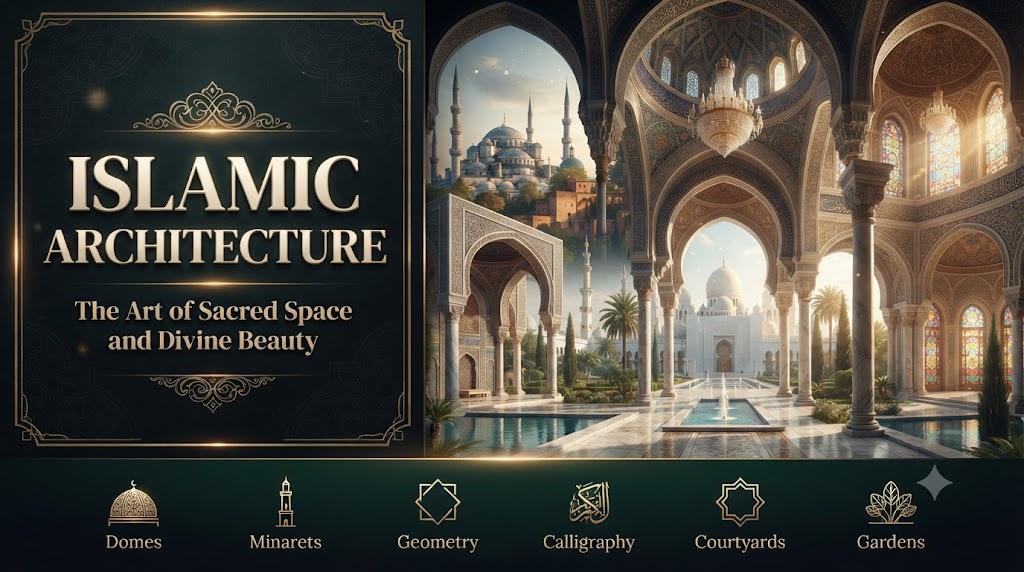
Islamic architecture represents distinctive artistic expression developing over fourteen centuries across vast geography—from Spain to China, from Sub-Saharan Africa to Southeast Asia. Characterized by certain recurring elements (dome, minaret, arch, courtyard, geometric ornamentation, calligraphic decoration), Islamic architecture also exhibits remarkable regional adaptation producing diverse expressions sharing underlying principles. Understanding this architectural tradition enriches appreciation of built environment while revealing theological and cultural values embedded in spatial forms.
Theological foundations shape Islamic architectural priorities. Mosques serve primarily as spaces for congregational prayer facing qibla (direction of Kaaba in Mecca)—this requirement determines fundamental orientation and layout. Modesty considerations influence separation of spaces. Avoidance of anthropomorphic imagery drives geometric and calligraphic decoration instead of figurative representation. Concept of barakah (divine blessing) associated with sacred spaces motivates investment in beauty befitting houses of worship. Architecture becomes vehicle for spiritual experience.
Dome (qubba) dominates mosque profiles symbolically and functionally. Symbolically, dome represents vault of heaven, cosmic shelter, and divine embrace. Functionally, dome acoustically amplifies adhan (call to prayer) and enables large column-free interior spaces. Dome evolution ranges from small semi-spherical versions to massive constructions like Dome of the Rock (Jerusalem, 691 CE) and Taj Mahal (Agra, 1653 CE). Engineering challenges of constructing large domes drove architectural innovation.
Minaret (manara) serves practical function of platform for mu’azzin’s call to prayer while becoming iconic visual marker of Islamic presence. Minaret styles vary regionally: square North African towers (like Kairouan’s), cylindrical Ottoman pencils (like Blue Mosque’s), Persian tile-covered spirals (like Samarra’s Malwiya), and Indo-Islamic chattris (like Taj Mahal’s). Height competition produced ever-taller minarets—Hassan II Mosque’s minaret reaches 210 meters, world’s tallest.
Arch forms distinguish Islamic architecture structurally and aesthetically. horseshoe arch (characteristic of Umayyad/Moorish architecture), pointed arch (later adopted by Gothic cathedrals), ogival arch, and multilobed arch provide structural solutions while creating rhythmic visual patterns. Arch construction enabled larger spans, higher walls, and more flexible layouts than post-and-lintel systems allowed. The arch became signature element identifying Islamic building traditions.
Courtyard (sahn) typically centers mosque layout, providing open-air space for overflow prayer, ablution facilities, and community gathering. Courtyard’s presence reflects climatic adaptation (providing shade and ventilation in hot climates) and social function (gathering space for community life). Often featuring fountain or pool for ritual washing (wudu) and psychological cooling effect, courtyards create microclimate oasis within urban settings.
Geometric ornamentation replaces figurative imagery prohibited in religious contexts (and minimized in secular ones). Mathematical patterns based on circle subdivision generate star polygons, tessellations, and infinite repeat patterns suggesting divine infinity. These designs require sophisticated geometric understanding while producing mesmerizing visual effects encouraging contemplation. Regional variations include: Andalusian complex interlace, Persian floral arabesques, Moroccan zellige tilework, and Mughal Pietra dura inlay.
Calligraphy elevates writing to major decorative art form. Quranic verses rendered in various scripts (Kufic, Thuluth, Naskh, Diwani) adorn mosque walls, domes, and entrances. Calligraphers become respected artists; masterworks command reverence approaching holy objects themselves. Integration of calligraphy with architecture makes text literally part of structural/spatial experience—words become environment.
Regional styles developed distinct characteristics reflecting local materials, climate, culture, and preceding architectural traditions. Moorish architecture (Spain) features horseshoe arches, elaborate stucco, and courtyard gardens. Ottoman architecture (Turkey/Balkans) emphasizes large domed spaces, slender minarets, and tile decoration. Persian architecture (Iran/Central Asia) produces iwan (vaulted hall) entrances, dome chambers, and extensive tilework. Mughal architecture (South Asia) blends Persian elements with Indian traditions, creating symmetrical complexes with bulbous domes and white marble. Swahili architecture (East African coast) combines Islamic forms with local coral stone construction and wooden carving.
Secular architecture applies similar aesthetic principles to palaces, caravanserais, baths, markets, and houses. Alhambra palace complex (Granada) represents peak secular Islamic architecture—courtyard gardens, reflecting pools, intricate stucco, and intimate spaces creating paradise-like environment. Caravanserais (roadside inns) facilitated trade network connectivity. Public baths (hammam) provided hygiene and social functions. Traditional houses centered on private courtyards with inward orientation protecting family privacy.
Contemporary Islamic architecture engages with modernity while referencing tradition. Major projects like Shah Faisal Mosque (Islamabad), Masjid Negara (Kuala Lumpur), and Sheikh Zayed Grand Mosque (Abu Dhabi) reinterpret traditional elements in modern idiom. Debates continue about appropriate balance between innovation and tradition, between international style and regional identity, between functional efficiency and symbolic richness. No consensus exists—but creative exploration continues vigorously.
Preservation challenges threaten historic Islamic architecture in many contexts. Conflict damage (Syria, Iraq, Yemen), neglect due to poverty, inappropriate modern development, tourism pressure, and climate change impacts endanger irreplaceable heritage. International organizations (ICOMOS, World Monuments Fund) and local efforts work to protect significant sites, but resources lag behind needs.
Experiencing Islamic architecture—whether through visiting, virtual tours, or photographic study—offers aesthetic pleasure, historical education, and spiritual enrichment. The spaces designed by generations of Muslim architects, builders, and patrons express theological values, cultural aspirations, and technical achievements worth understanding and preserving. Each mosque entered, each courtyard crossed, each dome viewed connects visitor with civilization spanning continents and centuries.