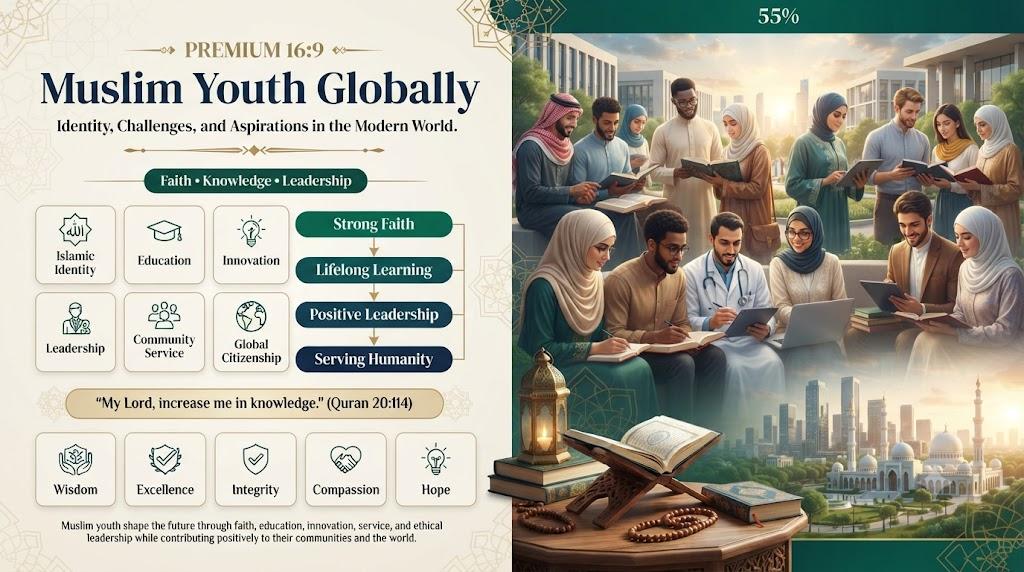
Muslim youth today constitute approximately half of global Muslim population—with median age of 24 compared to 30 for all people and 41 for those unaffiliated with any religion. This demographic bulge represents both tremendous opportunity and significant challenge for Islam’s future. Understanding young Muslims’ experiences, struggles, and aspirations enables better support for their journey toward faithful, productive adulthood contributing positively to both Ummah and broader society.
Identity formation for Muslim youth involves navigating multiple, sometimes conflicting, influences. Religious identity (Muslim) interacts with national identity (American, Egyptian, Malaysian, etc.), ethnic identity (Arab, South Asian, African, Turk, etc.), and generational identity (digital native, global citizen). Integration or conflict among these layers varies by context—some environments allow seamless combination while others force painful choices. Young Muslims creatively negotiate these boundaries, developing hybrid identities previous generations couldn’t imagine.
Religious practice levels among youth concern community elders who observe lower mosque attendance, less rigorous prayer observance, and relaxed dress codes compared to parental generation. Yet surface indicators may mask deeper engagement taking different forms—online religious learning, personalized spirituality, selective practice emphasizing inner devotion over outward conformity. Understanding youth religiosity requires looking beyond traditional metrics to assess genuine connection with faith.
Education systems shape Muslim youth differently across contexts. In Muslim-majority countries, public education often includes religious components (Islamic studies, Quran memorization) alongside secular subjects. Private Islamic schools offer more intensive religious formation sometimes criticized for isolation from broader society. Western Muslim youth attend secular schools with optional supplementary religious education (weekend schools, halaqah programs). Each system produces different knowledge bases, social connections, and identity outcomes.
Digital technology transforms youth experience fundamentally. Internet access exposes young Muslims to diverse interpretations of Islam—both enriching perspectives and confusing claims compete for attention. Social media creates global peer networks transcending local communities. Online religious content (lectures, apps, Q&A platforms) provides learning opportunities unavailable to previous generations. But digital spaces also host extremism recruitment, anti-Islam content, and distractions competing with spiritual development. Navigating digital landscape wisely becomes essential skill.
Employment and economic prospects worry young Muslims everywhere. Youth unemployment exceeds adult rates significantly in most Muslim-majority countries—sometimes reaching 25-30%. Underemployment, informal sector work, and brain drain (educated youth emigrating for opportunity) plague economies unable to absorb young workforce. Western Muslim youth face additional barriers: discrimination in hiring, credential recognition problems, and cultural mismatches with workplace norms. Economic anxiety delays marriage, household formation, and community contribution.
Marriage and family timing shifts occur across Muslim societies. Later marriage ages reflect extended education and economic preparation periods. Finding suitable spouses proves challenging—especially in minority contexts where potential partner pools shrink. Cross-cultural marriages increase, sometimes generating family tension. Divorce rates rise (though still below Western averages), particularly among educated women less willing to tolerate unhappy unions. These changes reshape family structures central to Islamic social organization.
Political engagement varies dramatically by context. In authoritarian Muslim-majority countries, youth political expression risks serious consequences—driving either apathy or radicalization. In democracies, Muslim youth voting rates, party affiliations, and issue priorities differ from elder cohorts. Identity politics attracts some youth repelled by mainstream parties’ failure to address Muslim-specific concerns. Civic participation beyond electoral politics (community organizing, advocacy, charity work) provides alternative engagement avenues.
Mental health concerns receive increasing attention as stigma decreases slightly. Anxiety, depression, and identity confusion affect Muslim youth at rates comparable to or higher than peers. Specific stressors include: Islamophobia experiences, family expectations pressure, faith doubts suppressed for fear of community rejection, sexuality/gender identity conflicts in conservative contexts, and general adolescent challenges amplified by minority status. Culturally competent mental health services remain scarce but growing.
Extremism vulnerability affects small percentage but demands serious attention. Recruitment tactics exploit genuine grievances (political injustice, identity crisis, search for meaning) offering false solutions through violent ideology. Prevention requires addressing root causes: political inclusion, economic opportunity, healthy identity formation, credible religious alternatives to extremist interpretations, and community support networks. Security-focused approaches alone backfire by confirming extremist narratives about Muslim persecution.
Aspirations expressed by Muslim youth reveal hopeful orientations despite challenges. Many want to contribute positively—through professional excellence, community service, artistic expression, or religious leadership. Entrepreneurial energy seeks halal market opportunities and social enterprise models. Creative talents produce music, literature, visual arts expressing Islamic sensibility in contemporary forms. Intellectual curiosity drives academic pursuit across fields. These energies, properly channeled, promise vibrant Islamic future.
Supporting Muslim youth requires multi-stakeholder approach. Families providing love while allowing appropriate autonomy; communities offering meaningful engagement beyond criticism; educational institutions preparing for success in this world and next; religious leaders speaking relevantly to contemporary concerns; policymakers removing structural barriers; and youth themselves taking ownership of development—all play necessary roles. Investment in youth yields returns across all human development indicators.
The Prophet himself placed special emphasis on youth—treating young companions with respect, entrusting them with significant responsibilities, and expressing hope for their future leadership. Following his example means taking young Muslims seriously as present contributors and future leaders, not merely as problems to be managed or futures to be postponed until they conform to elder expectations.