The preservation of prophetic traditions required extraordinary effort across generations of dedicated scholars who developed sophisticated methodologies, traveled vast distances, and sacrificed personal comfort to verify and transmit hadith accurately. Understanding this scholarly heritage deepens appreciation for hadith collections we possess today and highlights the community’s commitment to maintaining authentic connection with prophetic guidance.
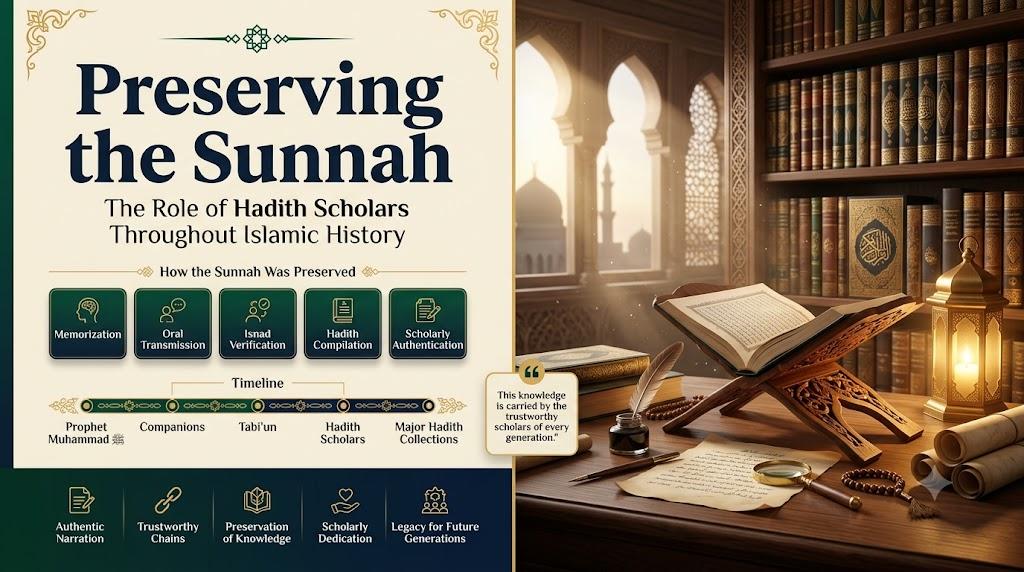
First-generation preservers were the companions (sahabah) who directly witnessed the Prophet’s words and actions. Their role involved not just observation but active preservation—memorizing statements, seeking clarification on ambiguous matters, and transmitting to students. Abu Hurairah reportedly transmitted over 5,374 hadiths, dedicating substantial portion of post-prophetic life to teaching. Aisha’s scholarly contributions included legal rulings derived from her intimate knowledge of household practices. These eyewitness accounts formed irreplaceable foundation for all subsequent transmission.
Successor generation (tabi’un) inherited from multiple companions, creating cross-referencing opportunities that strengthened verification. Scholars like Sa’id ibn al-Musayyib in Madinah, Hasan al-Basri in Basra, and Mujahid ibn Jabr in Mecca became renowned for hadith expertise. Their geographical spread meant traditions reached various centers where further verification occurred through comparative study.
Systematic compilation began in second century AH with works like Malik’s Muwatta—the earliest surviving hadith collection organized by legal topics. Malik’s Medinan school emphasized practice of local community as additional authentication factor beyond chain analysis. His methodology influenced subsequent compilers who would develop even stricter criteria.
The four-century golden age of hadith scholarship produced the canonical six collections (kutub sittah): Bukhari, Muslim, Abu Dawud, Tirmidhi, Nasa’i, and Ibn Majah. Each compiler traveled extensively—Ibn Majah visited Khurasan, Iraq, Hijaz, Egypt, and Syria collecting material. Tirmidhi’s collection uniquely grades each hadith’s authenticity status. Nasa’i specialized in identifying weaker narrators through detailed investigation. This diversity of approaches created robust cross-validation network.
Biographical sciences (ilm al-rijal) reached remarkable sophistication. Ibn Hibban’s “Kitab al-Thiqat” listed trustworthy narrators; Ibn Adi’s “al-Kamil” focused on weak ones; Dhahabi’s “Mizan al-I’tidal” provided balanced assessments. These reference works enabled later scholars to evaluate any hadith by examining each transmitter’s credentials—a system arguably more rigorous than modern historical methodology.
Regional hadith centers emerged as hubs of scholarly activity: Baghdad (housing Bukhari’s public readings drawing thousands), Nishapur (home of Muslim ibn Hajjaj), Cairo (where Ibn Hajar later composed major works), Cordoba (Andalusian center producing Ibn Abd al-Barr). Students migrated between cities to study with recognized masters, creating international scholarly network ensuring broad transmission base.
Female hadith scholars played surprisingly significant role despite patriarchal context. Karima bint Ahmad al-Marwazi taught Bukhari’s Sahih in Mecca for decades; Aisha bint Abdul-Hadi instructed major male scholars in Damascus; Zainab bint al-Kamal gave ijaza (teaching authorization) to Ibn Hajar al-Asqalani. These women’s contributions, often overlooked in popular narratives, were integral to preservation chain continuity.
Orientalist critiques in colonial era challenged hadith authenticity claims, prompting Muslim scholars to defend traditional methodologies while engaging critically with skeptical arguments. Figures like Mustafa al-Azami and Muhammad Mustafa Azami produced responses demonstrating hadith science’s internal coherence and historical reliability. Contemporary digital projects continue preservation through technology—online databases, manuscript digitization, and searchable indices expand access exponentially.
The preservation achievement becomes clearer when considering obstacles: political suppression under certain rulers, sectarian fabrication campaigns, geographical dispersion of sources, natural disasters destroying libraries, and sheer volume of material requiring management. That approximately 10,000-15,000 authentic prophetic traditions survive with full authentication chains represents miraculous success against odds.
Continuing preservation responsibility falls on current generation. Learning hadith basics, supporting scholarly institutions, utilizing authentic sources, and transmitting knowledge to next generation maintains chain stretching back to Prophet Muhammad. Each person who studies and applies authenticated hadith participates in living tradition that defines Islamic civilization’s intellectual heritage.
The scholars’ legacy isn’t merely academic artifact but living guidance system. Every Muslim who follows a verified sunnah benefits from centuries of verification work. Their dedication ensures that the Prophet’s example remains accessible—and our responsibility is to learn, apply, and preserve this inheritance for future believers.