
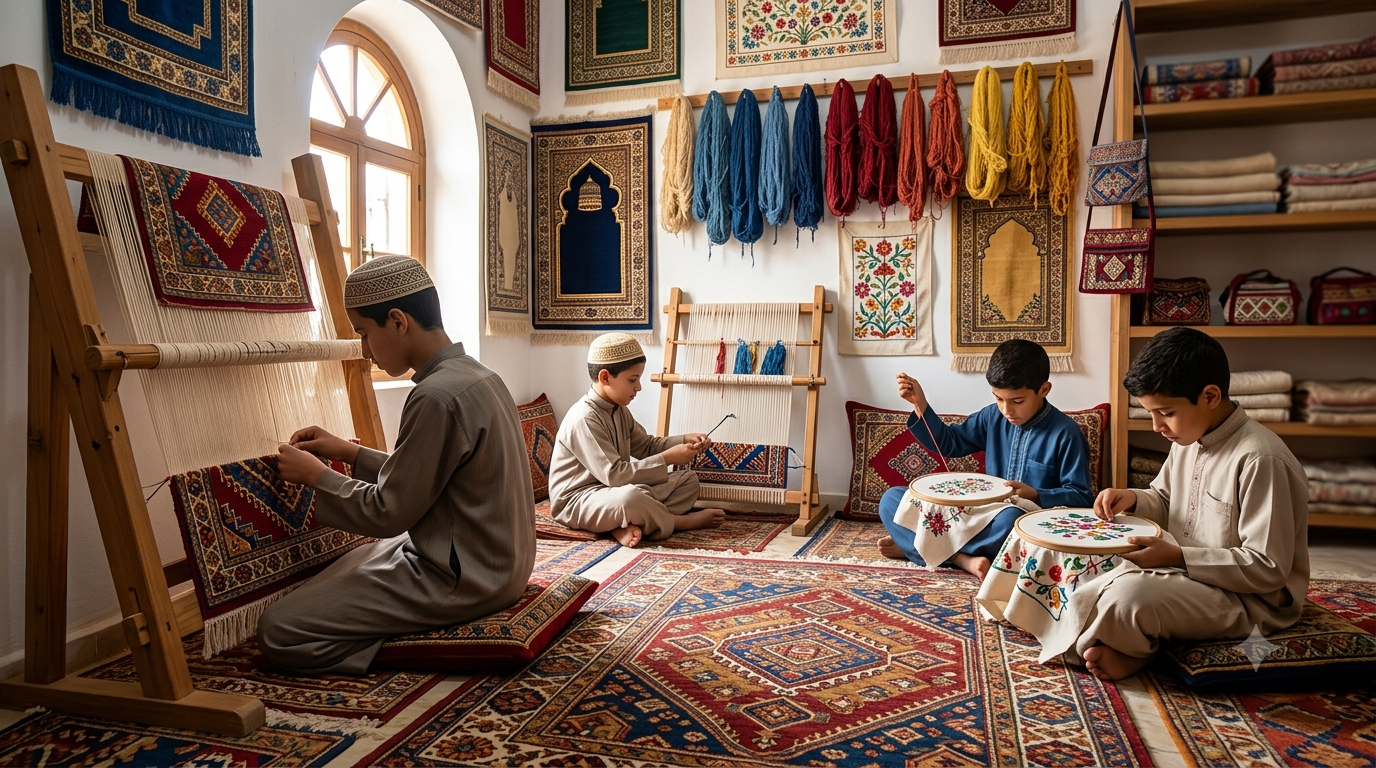
Textile arts hold privileged position in Islamic artistic tradition—carpets representing perhaps most internationally recognized Islamic art form, while textiles serve practical religious functions (prayer rugs, ihram garments, kiswa covering Kaaba) alongside domestic and ceremonial uses. Spanning weaving, embroidery, dyeing, printing, and embellishment, textile production absorbed enormous artistic energy and economic resources across Islamic history. Understanding Islamic textiles reveals intersection of artistry, commerce, daily life, and spiritual practice.
Carpet weaving stands as preeminent Islamic textile art. Persian carpets achieved legendary status for technical sophistication and aesthetic refinement—knot density sometimes exceeding million knots per square meter, designs ranging from geometric medallions to pictorial garden scenes, color palettes utilizing natural dyes for subtle harmonies. Turkish carpets (hereke, ushak, milas types) developed distinct regional characteristics. Central Asian carpets (Bukhara, Turkmen) featured bold geometric designs with tribal symbolism. Carpet
weaving (qazzaz) remained family-based craft passed through generations, with designs and techniques closely guarded secrets.
Prayer rug (sajjada) represents specialized carpet type serving religious function. Typically sized for individual worshipper, prayer rugs feature mihrab (prayer niche) motif indicating qibla direction, sometimes with lamp (symbolizing divine presence), water jar (purification), or garden (paradise) imagery. Portable prayer rugs enabled Muslims to pray anywhere on clean surface—essential before mosque carpeting became common. Collecting prayer rugs from different regions became marker of pilgrimage participation and cosmopolitan taste.
Embroidery (tatriz) decorated textiles across Islamic world. Palestinian thobe dresses feature distinctive regional embroidery identifying village of origin through specific patterns and colors. Ottoman court costumes displayed elaborate gold thread embroidery indicating rank and status. Uzbek suzani embroideries served dowry and household decoration purposes. Pakistani and Kashmiri shawls employed needlework techniques creating soft luxurious warmth. Embroidery allowed personal and domestic expression within parameters of modest dress requirements.
Dyeing techniques produced Islamic textiles’ characteristic colors. Indigo yielded blues ranging from pale sky to deep navy. Madder root produced reds from orange to crimson to burgundy. Saffron gave precious yellows (expensive, reserved for elite textiles). Walnut husks created browns; iron salts produced blacks and grays. Natural dye processes required expertise in mordanting (fixing color to fiber), timing, temperature control, and sequential dyeing for compound colors. Synthetic dyes eventually replaced many natural dyestuffs but couldn’t quite match their subtle variations.
Silk production and trade connected Islamic world to China via Silk Road routes. Persian silk weaving (especially brocade with metal thread) supplied imperial courts. Bursa (Ottoman Empire) became silk processing center handling raw Chinese silk and locally produced threads. Silk textiles indicated wealth and status—sumptuary laws sometimes restricted who could wear silk. Silk’s association with paradise (Quranic descriptions of silk garments) added spiritual connotation to luxury material.
Cotton production and processing underwent revolution under Islamic influence. Indian cotton cultivation spread westward through Islamic lands; by medieval period, cotton industry flourished in Egypt, Iran, and later Central Asia. Muslin (named for Mosul city) became prized lightweight fabric. Chintz (from Hindi chint) referred to printed cotton textiles. Cotton’s affordability compared to silk made it fabric for ordinary people while quality varieties served elites. Islamic world’s cotton processing techniques influenced European textile industry development.
Clothing and modesty (hijab) relate intimately to textile arts. Covering requirements generated demand for appropriate fabrics—opaque, breathable, modest in decoration yet beautiful. Veil (hijab, niqab) production involved specific textile treatments ensuring coverage while allowing vision and air circulation. Ihram garments for Hajj (unsewn white cloth) represent textile simplicity emphasizing equality before Allah. Textile choices express religious identity visibly—distinctive dress marking Muslim communities wherever they live.
Kaaba covering (kiswa) represents textile art’s most sacred application. Black silk cloth embroidered with gold Qur’anic verses covers Kaaba annually, replaced during Hajj season. Historical accounts describe caliphs and rulers competing for privilege of providing kiswa—demonstrating textile’s capacity for highest religious
expression. Production involves specialized artisans in dedicated facilities, using enormous quantities of silk and gold thread. Kiswa pieces distributed as blessings carry special barakah.
Contemporary textile production faces challenges from industrial competition. Machine-made carpets undercut handmade prices dramatically—consumers often cannot distinguish quality differences. Fast fashion reduces demand for traditional embroidery and quality textiles. Synthetic fibers and dyes replace natural materials, losing aesthetic qualities and cultural significance. Artisan communities struggle to maintain traditions when economic viability declines. Yet appreciation for handmade quality grows among discerning consumers, offering hope for sustainable niche markets.
Collecting Islamic textiles offers accessible entry point for Islamic art appreciation. Compared to paintings or sculptures, textiles remain relatively affordable while carrying deep cultural significance. Prayer rugs, fragments of larger textiles, vintage clothing items, and textile samples provide tangible connection to Islamic material culture. Careful collecting supports artisan communities and preservation of endangered techniques.
Textile arts ultimately reveal how beauty integrates with daily life in Islamic civilization. Not confined to museums or elite spaces, textiles surrounded Muslims from birth (swaddling clothes) through life (clothing, bedding, furnishings) to death (burial shrouds). This ubiquity made textiles primary medium for artistic expression reaching all social levels—democratizing beauty in ways fine arts couldn’t match. Every thread woven, every knot tied, every stitch sewn could be—and often was—act of devotion transforming craft into worship.


