
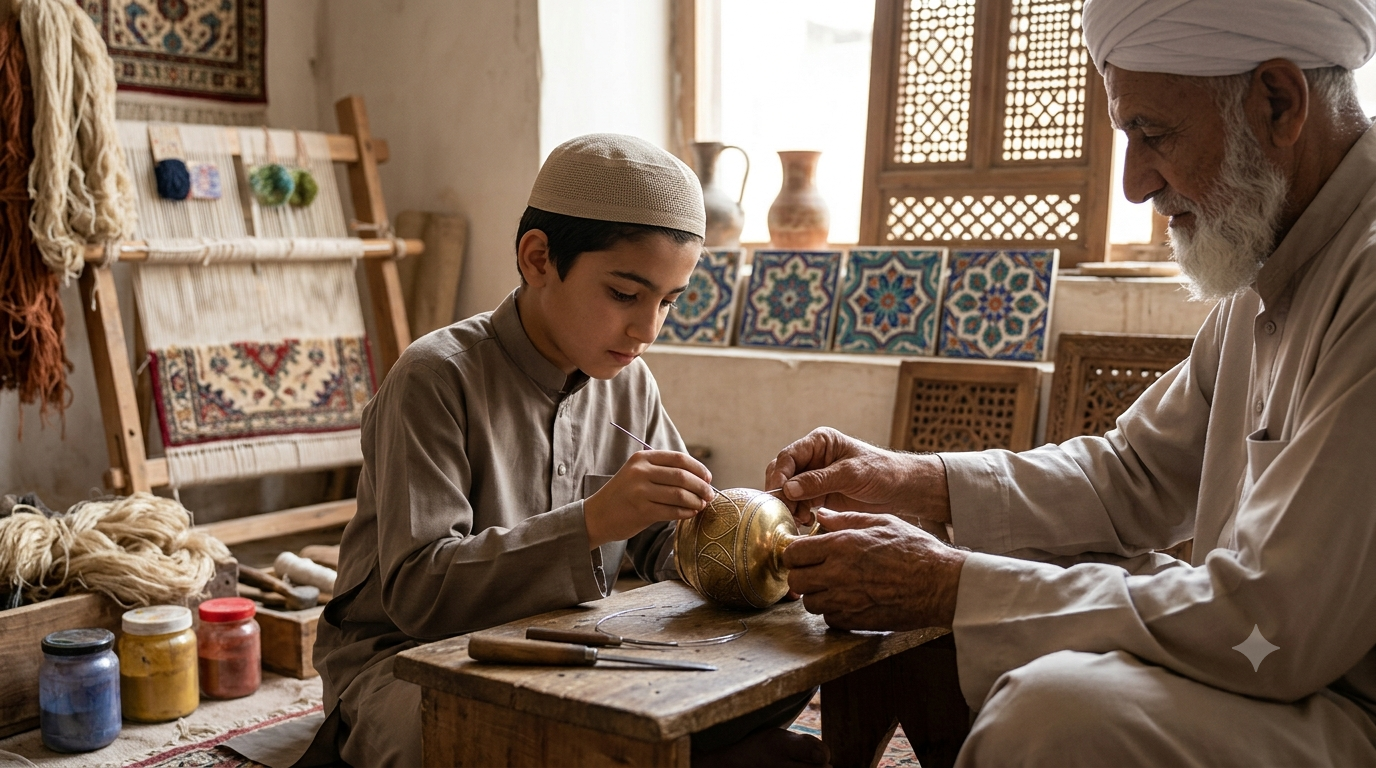
Traditional Islamic crafts encompass extraordinary range of artisanal skills developed over centuries—metalworking, ceramics, textiles, woodcarving, glassmaking, leatherwork, bookbinding, and more. These crafts produced functional objects of remarkable beauty while embodying cultural values, technical knowledge, and spiritual orientations. Understanding and supporting traditional crafts helps preserve tangible heritage while sustaining livelihoods for artisan communities continuing these practices.
Metalworking traditions achieved exceptional sophistication. Damascene steel (from Damascus, though originating in India) produced blades legendary for sharpness and distinctive surface patterning. Brass inlay (koftgari) decorated weapons and utilitarian objects with silver, gold, or copper wire pressed into prepared surfaces. Astrolabe construction required precision metalworking combined with astronomical knowledge. Lamp production for mosques created illuminated vessels of great beauty. Metalworkers (naqqash) held respected position in craft hierarchy.
Ceramic production reached heights in Persian, Turkish, and Chinese Islamic traditions. Iznik tiles (Ottoman Turkey, 15th-17th centuries) featured cobalt blue, turquoise, sage green, and red on white ground—decorating imperial buildings including Blue Mosque. Persian pottery developed lustreware technique giving metallic sheen to glazed surfaces. Chinese Islamic ceramics blended Chinese porcelain techniques with Arabic inscriptions and Islamic forms. Ceramicists (fakkhar) passed techniques through family lines, with secrets closely guarded.
Textile arts include weaving, embroidery, dyeing, and printing. Carpets from Persia, Turkey, and Central Asia remain highly valued—hand-knotting techniques taking months or years for single piece. Silk weaving (especially ikat resist-dyeing) produced luxurious fabrics for elite consumption. Embroidery decorated textiles for domestic and ceremonial use. Indigo and madder dyes created characteristic color palettes. Textile workers (ghazzaz) formed large professional guilds in major cities.
Woodcarving adorned architectural elements and furniture. Minbar (pulpit) carving demonstrated master craftsmen’s skill with intricate geometric and floral patterns. Mashrabiya (lattice screen) construction required precise joinery allowing complex geometric designs while functioning as privacy screen and ventilation device. Door carving often featured calligraphic inscriptions alongside decorative motifs. Woodworkers (najjar) utilized local timber species—walnut, teak, cedar, pine—depending on regional availability.
Glassmaking flourished especially in Egypt and Syria. Colored glass vessels used techniques inherited from Roman predecessors while developing Islamic stylistic features. Mosque lamps (misbah) hung in chains illuminating interior spaces with colored light through pierced metal fittings and glass body. Stained glass appeared in later periods, particularly in Mughal architecture. Glassmakers (zajjaj) maintained trade secrets for formulae producing characteristic colors.
Bookbinding represented convergence of multiple crafts. Leather preparation, tooling, gilding, paper treatment, and calligraphy combined in manuscript production. Illumination (tezhib) added gold and color decoration around text. Bookbinders (jallad) created protective covers often themselves artworks—tooled leather with stamped or painted designs, sometimes including flap enclosures (michlah). Manuscript production was collaborative effort involving scribes, calligraphers, illuminators, binders, and correctors.
Contemporary challenges threaten traditional craft survival. Industrial mass production undercuts handmade goods economically—younger generations often choose factory-made items over expensive artisan products. Training systems weaken as masters age without sufficient apprentices willing to undergo lengthy, poorly paid training periods. Raw material availability changes (traditional sources depleted, substitutes inferior). Market demand shifts toward modern aesthetics unfamiliar with traditional designs. Tourism provides some market but also encourages debased imitation production.
Revival efforts show promise in various locations. Cultural heritage organizations document techniques and support practitioners. Government programs promote traditional crafts through education and marketing assistance. Tourism revenue funds preservation workshops. International recognition (UNESCO Intangible Heritage listings) raises awareness and protection. Designer collaborations adapt traditional techniques to contemporary products reaching new markets. These efforts require sustained commitment across decades.
Ethical consumption supports craft communities. Purchasing authentic handmade items (rather than machine-made imitations) sustains artisan livelihoods. Paying fair prices (rather than bargaining down to below-subsistence levels) respects craft value. Learning about production processes builds appreciation justifying premium pricing. Sharing information about traditional crafts with others expands market awareness. Conscious consumers become heritage preservation partners.
Learning traditional crafts offers individuals meaningful engagement with heritage. Many destinations offer tourist workshops where visitors can try carpet-weaving, pottery, calligraphy, or metalwork under artisan guidance. Longer-term study programs enable serious skill development. Books and online resources provide instruction for those unable to travel. Even modest personal attempt at traditional craft deepens appreciation for masterworks encountered in museums and historic sites.
Crafts as spiritual practice deserves attention. Many traditional artisans approached work as devotional activity—Bismillah initiating action, intentions (niyyah) directed toward pleasing Allah, consciousness of barakah in honest labor, and excellence (ihsan) as worshipful standard. This transformed craft production from mere economic activity into potential source of blessing. Recovering this spiritual dimension enriches contemporary practice whether or not one is professionally artisan.
The future of traditional Islamic crafts depends on choices made now. Will we value handmade beauty sufficiently to pay its true cost? Will young people find craft careers attractive enough to sustain intergenerational
transmission? Will societies protect traditional knowledge from exploitation and neglect? Or will industrial efficiency and modern convenience finally extinguish practices developed over centuries? The answer lies partly in consumer decisions—every purchase of authentic handicraft votes for continuation of living heritage.


