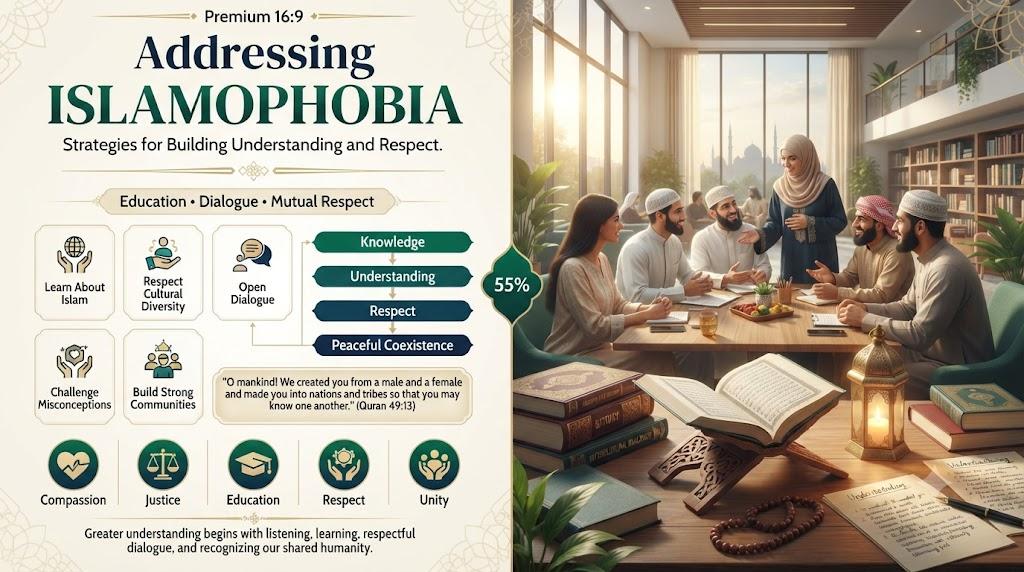
Islamophobia—prejudice against Islam and Muslims—has become defining challenge for Western Muslim communities and obstacle to genuine intercivilizational understanding. Manifesting through discrimination, hate crimes, media misrepresentation, and policy discrimination, anti-Muslim sentiment has risen significantly since 9/11 and particularly during recent political movements exploiting fear of “the other.” Effective response requires comprehensive strategy combining individual conduct, community organizing, political advocacy, and educational outreach.
Understanding Islamophobia’s roots helps address it effectively. Historical Christian-Muslim conflicts (Crusades, Ottoman expansion) created deep-seated stereotypes persisting in cultural memory. Colonial encounters produced racialized views of Muslims as backward, dangerous, or exotic. Israeli-Palestinian conflict generates emotional investment in delegitimizing one side’s narrative. Economic anxieties project onto visible “others” including Muslims. These layered causations mean simplistic counterarguments rarely persuade; nuanced engagement must address underlying fears.
Media representation plays crucial role in shaping public perception. Studies consistently show news coverage overrepresenting Muslims in terrorism contexts while underreporting Muslim victims of terrorism, ordinary Muslim life stories, and positive community contributions. Counter-strategies include developing Muslim journalists, supporting alternative media platforms, submitting letters-to-editor, filing complaints with press councils, and creating compelling content showcasing authentic Muslim experience.
Political rhetoric exploitation of Islamophobia demands organized response. Monitoring politicians’ statements, mobilizing voter registration and turnout, endorsing friendly candidates, and running Muslim candidates for office shift political calculations. Legal challenges to discriminatory policies (travel bans, surveillance programs, zoning restrictions) establish precedents protecting rights. Coalition-building with other targeted communities amplifies impact beyond Muslim numbers alone.
Educational interventions target various audiences. School curricula inclusion of accurate Islamic content prevents stereotype formation early. Workplace diversity training addresses adult misconceptions. University programs develop sophisticated understanding among future leaders. Mosque open days and interfaith visits provide direct experience countering abstract prejudices. Each educational setting requires tailored approach respecting audience characteristics.
Individual Muslim conduct represents perhaps most powerful anti-Islamophobia tool. Every positive interaction between Muslims and non-Muslims chips away at prejudice. Excellent professional performance, good neighborliness, ethical business dealings, civic participation—these normal behaviors collectively transform community image more effectively than any PR campaign. The burden of representing entire faith feels heavy, but reality assigns this role to visible minorities unavoidably.
Interfaith partnership builds allies against bigotry. Jews, Sikhs, Hindus, Buddhists, and Christians facing their own discrimination find common cause with Muslims. Joint statements, shared advocacy, mutual defense during crises create multipolar resistance to exclusionary movements. Theological dialogue, while not always easy, discovers shared values supporting cooperative action. Diverse religious coalition carries moral weight exceeding any single group’s voice.
Mental health impacts of living under hostile gaze deserve attention. Constant vigilance against discrimination, microaggressions in daily life, and trauma from violent incidents take cumulative toll. Community support systems, counseling resources attuned to minority stress, and spaces for processing difficult emotions build resilience. Ignoring psychological dimensions leaves individuals vulnerable while addressing only external factors.
Youth-specific strategies engage next generation differently than elders. Social media fluency enables young Muslims to control narratives directly. Cultural production (music, art, fashion, film) expresses identity in accessible forms. Campus organizations create supportive environments while educating peers. Youth leadership development ensures sustained effort as current activists age. Intergenerational coordination combines wisdom with innovation.
Measuring progress requires honest assessment alongside hope. Some indicators improve (public opinion polls showing decreasing negative views in certain demographics); others worsen (hate crime statistics rising in many jurisdictions). Regional variation is stark—some areas achieve remarkable coexistence while others deteriorate. Realistic appraisal guides resource allocation toward effective interventions rather than wishful thinking.
Ultimate confidence rests in divine promise that truth eventually prevails. Patience and persistence characterize prophetic approach to hostility—the Prophet endured thirteen years of Meccan opposition without retaliatory violence, trusting Allah’s timeline. Contemporary Muslims facing Islamophobia draw upon this spiritual reservoir while employing every legitimate means available for improving circumstances.
Building understanding is long-term project spanning generations. Each constructive conversation, each fair media portrayal, each political victory, each friendship across religious lines contributes incrementally to society where Muslims participate fully without prejudice. The work continues until such societies exist everywhere.