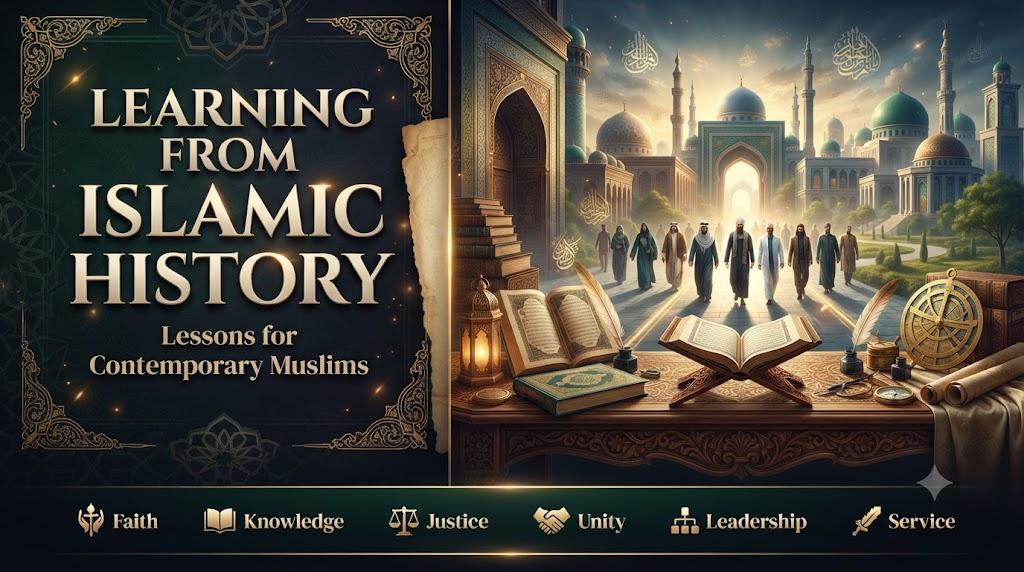
History isn’t merely past events collection but repository of lessons applicable to present challenges. Islamic history specifically offers guidance for contemporary Muslims navigating complex modern world—lessons about leadership, community building, knowledge pursuit, interfaith relations, resilience through difficulty, and balancing principles with pragmatism. Extracting these insights transforms historical study from academic exercise into practical resource for informed action.
Leadership lessons emerge clearly from examining caliphs, scholars, and rulers across Islamic history. Effective leaders combined competence with character—technical ability to manage affairs plus moral integrity preventing corruption. Abu Bakr’s humility, Umar’s accountability, Salahuddin’s chivalry, and numerous lesser-known examples demonstrate that leadership quality determines outcomes more than resources available. Contemporary Muslims in leadership positions (organizational, political, familial) can model these virtues.
Knowledge-seeking motivation drove Islamic civilization’s golden age. Scholars traveled enormous distances for single hadith, spent years mastering difficult texts, and debated passionately in pursuit of truth. This intellectual hunger contrasted with contemporary complacency accepting superficial understanding. Reclaiming scholarly ambition—whether in religious or secular fields—requires intentional cultivation of curiosity, rigor, and lifelong learning commitment exemplified by predecessors.
Interfaith relations models exist in Islamic history that inform contemporary pluralistic contexts. Constitution of Madinah established multi-religious polity with rights and responsibilities for all communities. Muslim rule in Spain (al-Andalus) produced periods of fruitful Jewish-Muslim-Christian collaboration (though not without tensions). Ottoman millet system managed religious diversity administratively. These historical examples don’t provide perfect templates but demonstrate possibility of constructive interfaith coexistence under Islamic governance.
Resilience through adversity appears repeatedly in Islamic history. Persecuted in Mecca, early Muslims maintained faith through torture, boycott, and eventual migration. Mongol destruction of Baghdad (1258 CE) devastated Islamic heartland but didn’t extinguish faith—centers shifted to Cairo, Delhi, Istanbul. Colonial domination disrupted traditional structures but couldn’t erase Islamic identity, which often strengthened resistance movements. Contemporary Muslims facing discrimination, conflict, or marginalization draw upon this resilience tradition.
Balance between principle and pragmatism characterize successful historical responses. The Prophet himself negotiated Treaty of Hudaybiyyah apparently unfavorable terms that ultimately enabled Mecca’s peaceful conquest. Companions differed on approaches (Ali’s strictness versus Muawiya’s flexibility) without excommunicating each other. Jurists developed principles for exceptional circumstances (darura permits normally prohibited things when necessary). This flexibility helps navigate situations where rigid adherence proves counterproductive.
Unity amidst diversity challenge has persisted since early fitna (civil strife) following Uthman’s assassination. Sectarian, ethnic, theological, and jurisprudential differences have always existed within Muslim community. Historical periods of relative unity (under Rashidun caliphs, certain imperial moments) alternated with fragmentation. What held community together wasn’t uniformity but shared commitment to core beliefs plus tolerance for legitimate difference. Contemporary Muslims facing internal divisions can learn from both unity-building strategies and acceptance of unavoidable diversity.
Women’s historical roles exceed stereotypes limiting them to private sphere. Khadijah’s entrepreneurship, Aisha’s scholarship, Fatima al-Fihriya’s institutional founding, and numerous less famous examples demonstrate women’s public participation throughout Islamic history. Recovering this history empowers contemporary Muslim women claiming full participation while responding to claims that Islam inherently restricts female agency.
Environmental stewardship appears in Islamic teachings and historical practices. The Prophet’s conservation instructions (not wasting water even at flowing river, planting trees, protecting animals), traditional Islamic city design incorporating green spaces, and agricultural sustainability practices offer resources for contemporary environmental ethics. Historical Muslim societies often lived in greater harmony with local ecosystems than industrial alternatives—suggesting return to principles might inform current ecological challenges.
Economic justice teachings address contemporary inequality. Zakah’s redistributive mechanism, prohibition of riba (interest) preventing exploitation, encouragement of charity beyond obligation, and critiques of hoarding and extravagance provide framework for addressing wealth gaps. Historical implementations varied in effectiveness but principles remain relevant for contemporary economic ethics discussions.
Technological engagement has precedent in Islamic civilization’s scientific achievements. Muslims weren’t always suspicious of innovation—they led it during Golden Age. Cautious engagement with AI, biotechnology, genetic engineering, and other emerging technologies can draw upon historical comfort with knowledge pursuit while maintaining ethical guardrails that classical scholars also observed.
The cycle of rise and decline (Ibn Khaldun’s analysis) warns against complacency. Civilizations flourish through cohesion (‘asabiyyah), hard work, justice, and openness to knowledge; they decline through luxury, injustice, factionalism, and stagnation. Contemporary Muslim societies experiencing various stages of this cycle can apply diagnostic insights to current conditions—strengthening positive factors while countering negative trends.
Ultimately, history teaches that circumstances change but principles endure, that human nature remains constant across eras, that sincere effort blessed by Allah produces results beyond expectation, and that trials precede victories. Muslims studying their history with open minds find both inspiration for present struggles and cautionary tales warning against repeating past mistakes. The past isn’t merely prologue—it’s teacher for those willing to learn.
WOMEN & FAMILY IN ISLAM
Insights on Family Values, Women’s Rights, and Islamic Living