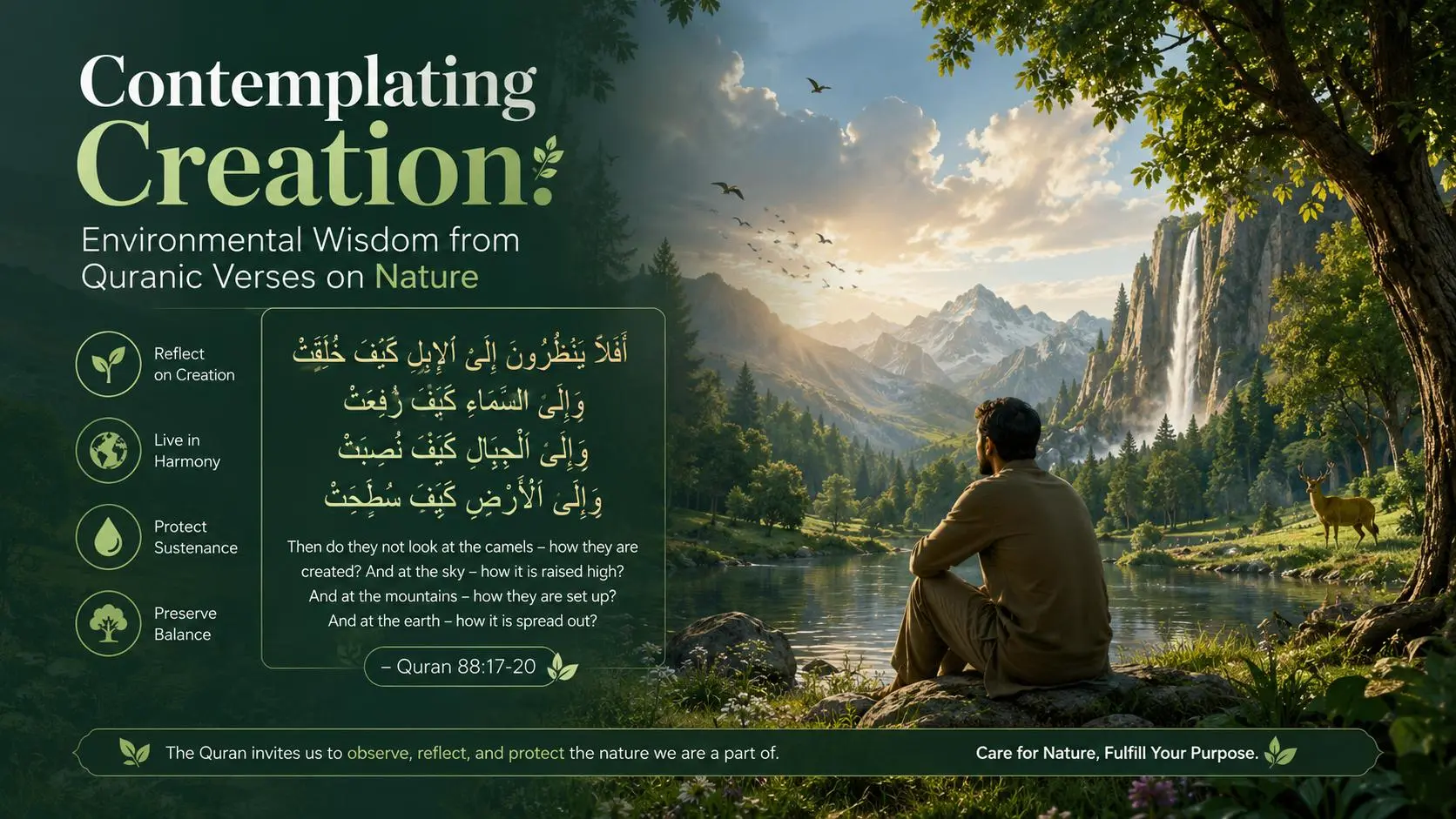
The Quran presents the natural world as a book of signs (ayat) parallel to revelation itself, inviting observation, reflection, and responsible stewardship. Long before environmental crises made ecological awareness urgent, Islamic scripture established principles for harmonious relationship between humanity and the biosphere. Revisiting these teachings today offers both spiritual enrichment and practical guidance for addressing planetary challenges.
The creation narrative in the Quran emphasizes balance (mizan) and purposeful design. “And the heaven He raised and imposed the balance” (Rahman: 7) establishes cosmic equilibrium as divine mandate. “And there is not a thing except that with Us are its treasuries, and We do not send it down except according to a known measure” (Hijr: 21) indicates precise governance of natural resources. These verses suggest that environmental disruption violates created order, with consequences flowing from transgressing established limits.
Water receives special attention as the basis of life: “Have those who disbelieved not considered that the heavens and the earth were a joined entity, and We separated them and made from water every living thing?” (Anbiya: 30). The water cycle’s description—evaporation from oceans, cloud formation, rainfall distribution—appears in multiple surahs with accuracy that continues impressing scientists. Beyond scientific interest, these passages establish water as divine gift demanding grateful preservation rather than wasteful exploitation.
Biodiversity finds Quranic affirmation: “And whatever He created on the earth, every crawling creature of flying creature—They are communities like you” (An’am: 38). This verse radically democratizes existence, granting other species communal status equivalent to human societies. The implication for conservation ethics is profound—if other creatures form communities with their own purposes and rights before God, human treatment of them must account for more than mere utility.
The principle of corruption (fasad) and its prohibition appears repeatedly: “Corruption has appeared throughout the land and sea by [consequence of] what the hands of people have earned so He may let them taste part of [the consequence of] what they have done that perhaps they will return [to righteousness]” (Rum: 41). This verse explicitly links environmental degradation to human action and frames remediation as religious obligation. Contemporary climate science confirms anthropogenic causes of planetary disruption, making this warning urgently relevant.
Consumption patterns receive guidance through concepts like israf (waste) and tabdhir (extravagance). “Indeed, the wasteful are brothers of the devils, and ever has Satan been to his Lord ungrateful” (Isra: 27). Moderation (iqtasad) represents the virtuous mean between deficiency and excess. These principles apply directly to resource use, consumer behavior, and development choices facing modern societies.
Animal welfare appears in prohibitions against hunting during pilgrimage months and instructions to slaughter with sharp knives minimizing pain. The Prophet’s specific commandments—not to sharpen blades before animals, not to kill for sport, to provide water before milting—extend Quranic principles into detailed practice. Such traditions suggest comprehensive Islamic ethic for creaturely care.
Stewardship (khilafah) rather than domination best captures the human role assigned by Quranic cosmology. “It is He who has made you successors (khalifah) upon the earth” (Fatir: 39). Successors hold authority in trust, accountable to the One who delegated responsibility. This framework contrasts sharply with exploitative attitudes treating nature as mere resource for unlimited extraction.
Practical application includes supporting sustainable agriculture, reducing carbon footprints, protecting endangered species, and advocating policies reflecting Islamic environmental ethics. Individual actions—conserving water, avoiding plastic waste, choosing ethical products—accumulate into collective impact when practiced by communities of faithful.
The spiritual dimension connects ecological concern to tawhid. Respecting creation honors its Creator; abusing creatures insults their Maker. Environmental responsibility thus becomes worship expression, not merely pragmatic necessity. This integration of material care with spiritual motivation distinguishes Islamic approach from secular environmentalism.
As planetary boundaries face unprecedented pressure, returning to Quranic environmental wisdom offers pathways toward sustainability grounded in transcendent purpose. The same revelation guiding individual salvation also contains principles for collective survival—if only we would read with eyes willing to see.