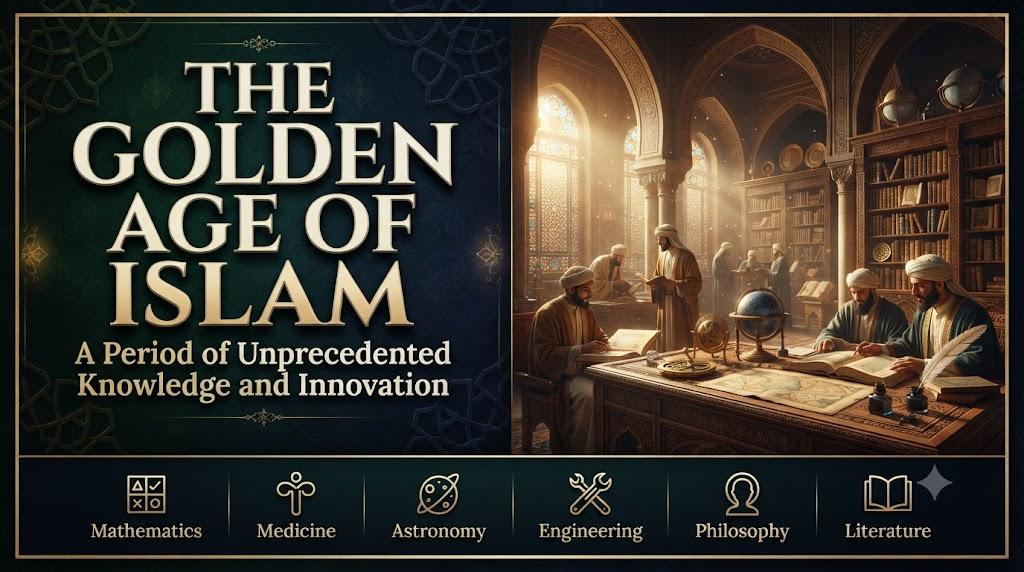
The Islamic Golden Age (approximately 8th-14th centuries CE) represents one of history’s most remarkable periods of intellectual flourishing. Spanning from Abbasid Caliphate’s establishment in Baghdad through Mongol invasion’s disruption, this era produced advances in science, philosophy, medicine, technology, and arts that shaped human civilization fundamentally. Understanding this period counters narratives of inherent civilizational conflict while inspiring contemporary Muslim engagement with knowledge.
Baghdad’s founding in 762 CE by Caliph al-Mansur established center for subsequent development. Strategically located on Tigris River, the Round City became world’s most populous metropolis within decades. Its design reflected cosmic symbolism—concentric circles representing celestial order. This urban foundation enabled concentration of scholars, resources, and patronage that catalyzed intellectual revolution.
Bayt al-Hikma (House of Wisdom) epitomizes Golden Age institution. Founded as library, it evolved into research academy, translation bureau, and publishing house under Caliph al-Ma’mun’s enthusiastic support. Scholars of diverse backgrounds—Muslims, Christians, Jews, Zoroastrians—collaborated on translating Greek, Persian, Indian, and Syriac works into Arabic while conducting original research. This multicultural, multilingual environment generated unprecedented knowledge synthesis.
Translation movement preserved classical heritage while launching Islamic scholarship. Works by Aristotle, Galen, Ptolemy, Euclid, and countless others survived because Muslim scholars valued and transmitted them. Translators like Hunayn ibn Ishaq (who reportedly earned per corrected manuscript page) established standards for scholarly accuracy. Without this effort, much ancient wisdom would have been lost to European Middle Ages.
Mathematics saw revolutionary developments. Al-Khwarizmi systematized algebra (his name gives us “algorithm”); his book Kitab al-Jabr introduced systematic equation solving. Al-Karaji extended algebraic methods; Omar Khayyam solved cubic equations geometrically. Decimal positional numbering reached Islamic world from India, spreading eventually to Europe through Arabic texts. Trigonometry developed independently for astronomical purposes.
Medicine advanced significantly through figures like Ibn Sina (Avicenna), whose Canon of Medicine served as European textbook for centuries. Al-Razi (Rhazes) differentiated smallpox from measles, wrote clinical observations still studied. Ibn al-Nafis described pulmonary circulation centuries before Harvey. Hospitals (bimaristans) with specialized wards, medical libraries, and teaching functions modeled institutions later adopted in Europe.
Optics science transformed through Ibn al-Haytham’s experimental method. His Book of Optics overturned Greek emission theory, establishing intromission theory with experimental proof. Perspective geometry, camera obscura principles, and scientific methodology he pioneered influenced Roger Bacon and Renaissance art techniques for realistic representation.
Philosophy engaged reason with revelation productively through scholars like al-Kindi (first Muslim philosopher), al-Farabi (political philosophy), Ibn Sina (metaphysics), and Ibn Rushd (Averroes) who commented extensively on Aristotle. These thinkers developed sophisticated systems integrating Greek thought with Islamic principles, influencing medieval Scholasticism significantly through Latin translations.
Astronomy reached sophisticated levels supporting both scientific curiosity and religious practice (prayer time calculation, qibla direction). Observatories at Baghdad, Damascus, Samarkand, and elsewhere housed instruments enabling precise observations. Astronomical tables (zij) facilitated navigation and timekeeping. Al-Biruni’s mathematical geography calculated earth’s dimensions with impressive accuracy.
Literature flourished alongside sciences. Poetry remained prestigious art form; pre-Islamic odes were preserved alongside new compositions. One Thousand and Nights (Alf Layla wa-Layla) entered world literature canon. Travel writing (Ibn Battuta’s Rihla) provided geographic and ethnographic knowledge. Maqamat literature developed picaresque narrative forms anticipating modern fiction.
Factors enabling Golden Age included: political stability under strong caliphates, economic prosperity from trade, patronage by rulers and wealthy individuals, geographic position connecting civilizations, tolerance for diverse intellectual approaches, and cultural value placed on learning. When these conditions eroded—through political fragmentation, Mongol devastation, and intellectual narrowing—Golden Age declined.
Legacy endures today. Many English words derive from Arabic (algebra, algorithm, chemistry, admiral). Numerals we use are “Arabic numerals.” Stars bear Arabic names (Betelgeuse, Aldebaran, Deneb). Universities descend from Islamic institutional models. Scientific method owes debt to Islamic empirical approach. This heritage belongs to all humanity while holding special significance for Muslims as demonstration of faith’s compatibility with excellence.