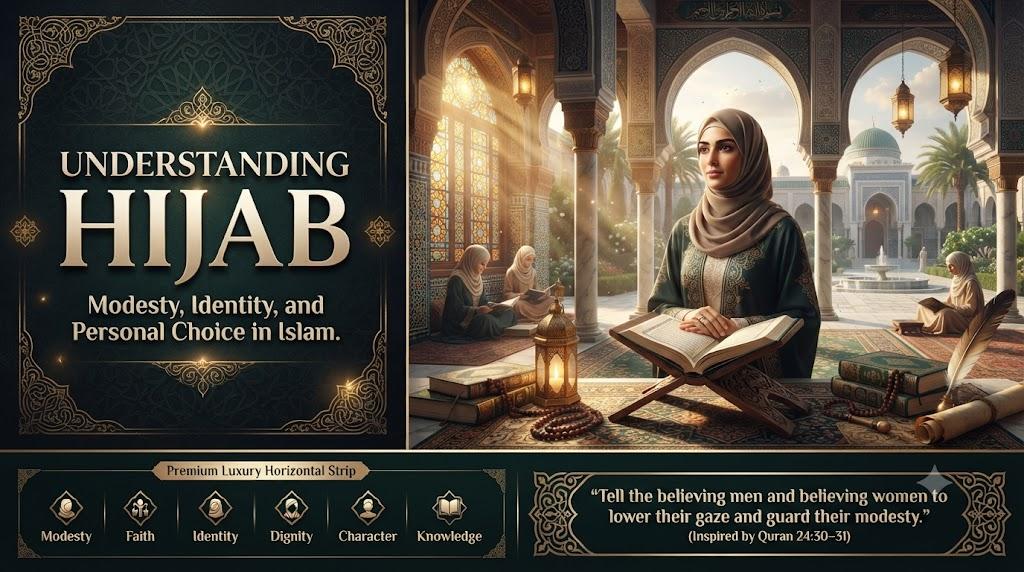
Hijab, literally meaning “barrier” or “cover,” refers to Islamic modesty requirements encompassing behavior, dress, and demeanor for both men and women. While commonly associated with women’s head covering, hijab’s comprehensive scope includes guidelines for men’s gaze, dress, and conduct. Understanding hijab’s theological basis, historical variations, and contemporary expressions enables respectful engagement with this often-misunderstood practice.
Quranic foundation appears primarily in verse 31 of Surah An-Nur: “Tell believing women to lower their gazes and guard their private parts and not display their beauty except what necessarily appears thereof, and to wrap [a portion of] their headcovers over their chests…” This command establishes principles: lowering gaze (modest visual engagement), guarding chastity, concealing adornment (zinah), and specific covering directive using khimar (head covering) drawn over juyub (chest area). The verse balances modesty requirements with recognition that some appearance is unavoidable.
Another key verse (Ahzab: 59) instructs Prophet: “O Prophet, tell your wives and your daughters and women of the believers to bring down over themselves [outer] garments.” Context involved harassment of women in early Madinan mosque, making outer garment (jilbab) protective measure identifying believing women as off-limits to harassers. This situational aspect informs interpretation regarding how much covering circumstances require.
Men’s hijab receives explicit Quranic attention too: “Tell believing men to lower their gazes and guard their private parts. That is purer for them” (An-Nur: 30). Men’s dress guidelines appear in hadith literature prohibiting silk, gold, and imitating opposite gender. Lowering gaze applies equally to both sexes—mutual responsibility characterizes Islamic modesty, not unilateral burden on women.
Prophetic practice modeled hijab for following generations. After the verses revealed, the Prophet’s wives and believing women adopted covering that became standard practice. Descriptions mention garments covering body completely, sometimes leaving only one eye visible (niqab). However, variation existed—some women covered faces, others didn’t; styles differed by region, class, and personal choice. The principle allowed flexibility in implementation.
Classical juristic debate focused on which body parts constitute ‘awrah (nakedness requiring cover) for women. Majority opinion (Maliki, Shafi’i, Hanbali) holds that everything except face and hands must be covered in presence of non-mahram men. Hanafi school includes feet in obligatory coverage. Minority views (some Hanbalis) consider face part of ‘awrah. These scholarly differences allow legitimate variation in practice.
Contemporary expressions range widely: full covering (niqab/burqa), hijab (headscarf covering hair and neck), loose clothing without head covering (practiced by some Muslims interpreting requirements differently), and occasional non-observance. Each position has defenders within Islamic scholarly tradition. Judgment about individuals’ choices should be reserved for Allah who knows hearts and intentions.
Personal choice dimension deserves emphasis. While hijab is religious obligation according to most mainstream interpretations, manner and extent of compliance involves personal decision-making process. Coercion—whether forcing someone to wear hijab or preventing them from doing so—violates Islamic principles of no compulsion in religion. Community norms influence but don’t determine individual practice.
Identity politics surrounding hijab complicate discussion. For some, hijab represents religious commitment and cultural pride; for others, it symbolizes oppression requiring liberation; for others still, it’s simply personal preference without political significance. These varied meanings coexist, making blanket statements inadequate. Listening to individual women explain their own choices reveals complexity reduction misses.
Workplace and social accommodation of hijab continues evolving. Legal protections increasingly recognize religious dress rights, though enforcement varies. Professional environments adapt uniform policies for hijab compatibility. Sports federations develop modest athletic wear options. These practical adjustments enable observant Muslim women fuller participation in public life.
Non-Muslim perceptions of hijab range from curiosity through respect to hostility. Misconceptions abound: that it’s forced (often it’s chosen), that it signifies oppression (many wearers feel empowered), that it’s anti-modern (hijab fashion industry thrives creatively), that women who don’t wear it aren’t “good Muslims” (only Allah judges). Education and interfaith contact improve understanding, reducing prejudice based on appearance.
Men’s role in hijab discourse requires attention. Sometimes men dominate conversations about women’s dress—whether enforcing or criticizing. More productive approach involves men focusing on their own modesty obligations (gaze control, dress, conduct) while supporting women’s autonomous decisions about their bodies. Allyship means defending women’s right to choose without dictating what that choice should be.
The spiritual purpose of hijab—cultivating modesty that reflects inward piety outwardly—should remain central in discussions. External compliance without internal transformation misses point; yet internal transformation often manifests externally. Balance between avoiding judgment (of those who cover differently or not at all) and maintaining standards creates healthy community dynamic.
Ultimately, hijab represents Muslim woman’s personal response to divine command, shaped by understanding, context, and conviction. Respect for diverse expressions within Islamic framework honors both religious obligation and human dignity in choosing how to fulfill it.