Surah Al-Ikhlas, comprising only four short verses, carries weight far exceeding its length. The Prophet Muhammad (peace be upon him) equated reciting it with reading one-third of the Quran, indicating its concentration of essential theological truth. In an era of increasing spiritual confusion, this surah provides clarity about Allah’s nature that protects against both anthropomorphism (likening God to creation) and nihilism (denying His reality altogether).
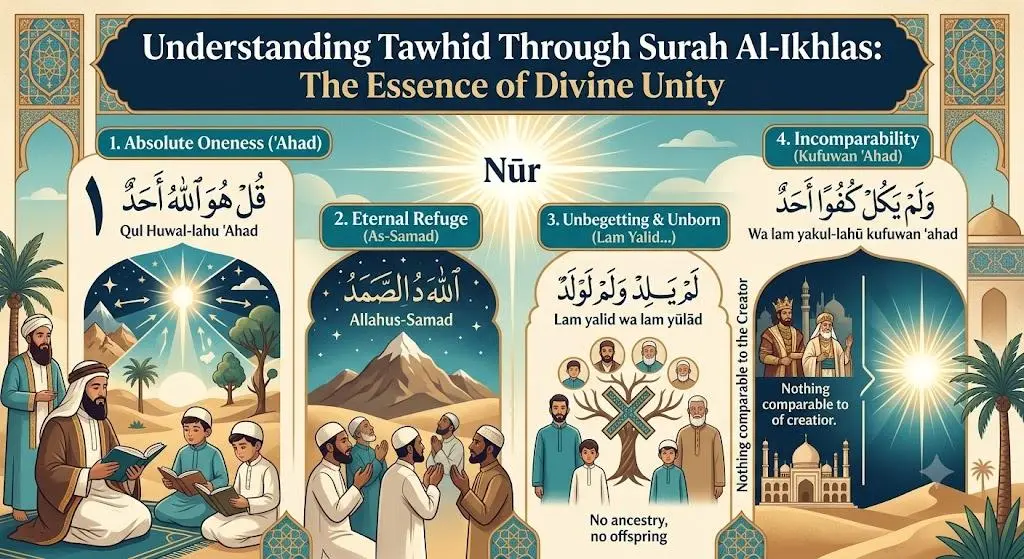
The first verse, “Qul Huwa Allahu Ahad” (Say, ‘He is Allah, [who is] One’), establishes absolute unity. Unlike trinitarian or polytheistic conceptions of divinity, Islam affirms God’s singular essence without partners, divisions, or gradations within His being. This Oneness (Ahadiyyah) is not merely numerical singularity but qualitative uniqueness—nothing resembles Him in any respect. Understanding this concept transforms how believers approach worship, knowing they direct devotion to a reality utterly distinct from created things.
“Allahu Samad” (Allah the Eternal Refuge) describes Allah as the ultimate destination of all needs while being Himself self-sufficient. Everything in creation depends upon Him for existence, sustenance, and purpose; He depends upon nothing. This asymmetry defines the creature-Creator relationship properly. Humans who forget this truth fall into error either by depending on other than Allah for what only He can provide, or by imagining that Allah needs their worship. Samad thus corrects both dependency on the inadequate and arrogance about our own significance.
“Lam yalid wa lam yulad” (He neither begets nor is born) specifically addresses misconceptions prevalent among pre-Islamic Arabs and neighboring religious communities. Some claimed Allah had daughters (the angels); Christians affirmed divine sonship; Zoroastrians posited cosmic duality between light and darkness principles. By negating both progeny and parentage, Al-Ikhlas asserts Allah’s transcendence of biological categories and temporal processes. He is not part of any chain of causation or succession.
“Walam yakun lahu kufuwan ahad” (Nor is there to Him any equivalent) completes the description by denying any comparable reality. No entity shares His essence, attributes, or actions. This final verse prevents the subtle error of imagining multiple independent powers in the universe—even if one is called “God” and others “nature” or “chance.” Absolute monotheism leaves room for no competing causal forces.
The practical implications of Al-Ikhlas extend throughout Muslim life. In worship, it demands sincerity (ikhlas)—acting purely for Allah’s sake without mixed motives. In ethics, it requires attributing harm and benefit correctly to divine decree rather than superstitious sources. In community, it underlies equality before God regardless of social distinctions. The surah’s very name connects theological truth to psychological purity.
Scholars note that Al-Ikhlas was revealed when polytheists asked the Prophet to describe his Lord’s lineage, attempting to fit Allah into their genealogical categories. His response dismantled their conceptual framework entirely. Similarly today, when people attempt to understand God through limited human analogies—father figure, cosmic force, moral ideal—Al-Ikhlas redirects attention to what God has revealed about Himself.
Memorizing, reflecting upon, and frequently reciting Al-Ikhlas purifies the heart from hidden shirk (associating partners with Allah). The Prophet recommended it for various occasions: before sleep, after prayers, and as expiation for gatherings. Its constant presence in Muslim devotional life maintains theological clarity amid confusing ideologies.
In times when many seek spirituality without defined doctrine, Al-Ikhlas offers both precision and depth. It satisfies the intellect’s need for coherent theology while inspiring the heart’s capacity for wonder before the incomparable Divine. Four verses, perfectly chosen, contain enough contemplative material for a lifetime of growing understanding.