Projecting the global Muslim community’s trajectory requires analyzing demographic trends, economic developments, political dynamics, technological changes, and religious evolution. While prediction always involves uncertainty, identifying key drivers and potential scenarios enables strategic planning for individuals, organizations, and communities invested in Ummah’s flourishing. The future isn’t predetermined—collective choices made today shape what emerges tomorrow.
Demographic momentum favors continued Muslim population growth through mid-century. Higher fertility rates in Muslim-majority regions, relatively young age structure, and geographic concentration in high-growth areas suggest Muslims will approach Christians in absolute numbers by 2050-2060, potentially becoming world’s largest religious group thereafter. Regional distribution will shift—sub-Saharan Africa’s rapid growth means greater African Muslim proportion; Asian dominance continues but with changing internal balances (Indonesia gaining relative to South Asia). Europe and Americas’ Muslim populations grow mainly through natural increase of existing communities rather than new immigration.
Economic trajectories present mixed picture. Resource-rich Gulf states leverage oil wealth for diversification into finance, tourism, and technology—but transition success varies. Major Muslim-populated countries (Indonesia, Turkey, Malaysia, Bangladesh) show strong growth trajectories lifting millions from poverty. Others (Pakistan, Egypt, Nigeria) struggle with debt, corruption, and governance challenges limiting potential. Economic inequality within and between Muslim countries raises justice questions Islamic tradition addresses directly through zakat and prohibition of riba.
Technological adaptation determines competitiveness in knowledge economy. Current indicators show mixed results: some Muslim-majority countries invest heavily in research and development (Malaysia’s biotech focus, UAE’s Mars mission, Turkey’s defense industry); others lag significantly in patent production, scientific publishing, and innovation metrics. Digital connectivity spreads rapidly—smartphone penetration, social media use, and e-commerce adoption match global patterns. But technology creation (not just consumption) requires educational and institutional foundations still developing in many contexts.
Environmental challenges threaten Muslim-majority regions severely. Climate change impacts hit hard: water scarcity in Middle East and North Africa, flooding in coastal Bangladesh, agricultural disruption in Sahel, heat extremes across South Asia. Many Muslim countries rank high on climate vulnerability indices while contributing relatively little to emissions causing problem. Response capacity varies—wealthy states can adapt; poor ones face existential threats. Islamic environmental ethics provide framework for green transitions but implementation lags behind need.
Political stability remains elusive in key regions. Syria, Yemen, Libya, Somalia, and Afghanistan experience prolonged conflicts with no clear resolution. Authoritarian governance persists across many Muslim-majority states, suppressing civil society capacity needed for adaptive problem-solving. Democratic experiments (Tunisia, Sudan, Malaysia) face setbacks. External interventions (great power competition, proxy wars) complicate internal political evolution. Governance quality largely determines whether other potentials realize.
Religious evolution continues internally. Reformist movements push for reinterpretation of texts, reassessment of classical jurisprudence, and contextual application of eternal principles. Traditionalist responses defend inherited consensus against perceived innovation. Sufi revival offers spiritual depth appealing to many youth. Salafi influence persists despite setbacks. Sectarian tensions (Sunni-Shia) occasionally flare violently. This internal diversity generates creativity but also conflict requiring careful navigation.
Women’s roles transform across Muslim societies—perhaps the most significant social change underway. Education levels rise dramatically (surpassing men in tertiary enrollment in many Muslim countries). Labor force participation increases despite remaining below global average. Political representation grows slowly. Family law reforms advance in some contexts while regressing in others. Women’s religious scholarship expands, reclaiming interpretive authority historically monopolized by men. These changes reshape families, communities, and ultimately entire societies.
Ummah consciousness itself evolves under globalization pressures. National identities strengthened by colonial state formation sometimes compete with pan-Islamic solidarity. Digital connectivity enables transnational Muslim community feeling that geography previously hindered. Crisis response (Palestine, Rohingya, Uyghurs) activates Ummah identity spontaneously. But日常 cooperation across Muslim states remains limited by political rivalries and economic competition. The tension between ideal unity and practical fragmentation likely continues.
Scenarios for 2075 range widely. Optimistic projection sees integrated economic zone, resolved major conflicts, technological leadership in key sectors, environmental sustainability achieved, and religious renewal producing vibrant contemporary Islam. Pessimistic scenario features prolonged conflicts, economic stagnation, environmental catastrophe, religious extremism, and civilizational decline. Most probable path falls somewhere between—progress in some areas, regression in others, with outcome depending on choices made by billions of individuals and thousands of institutions.
Individual agency matters within macro trends. Every Muslim choosing education over ignorance, ethical career over corrupt opportunity, family formation over hedonism, community engagement over isolation, and faithfulness over apostasy contributes to aggregate outcome. Collective action through organizations amplifies individual choices. Strategic philanthropy directs resources toward high-leverage interventions. Advocacy shapes policy environments enabling or constraining positive development.
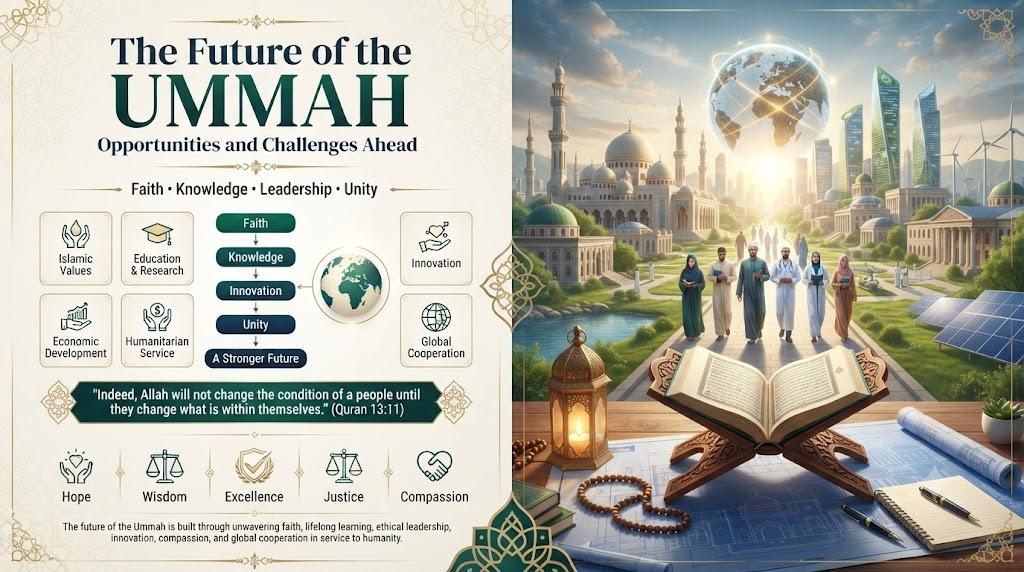
The Quran promises that Allah does not change condition of people until they change what is in themselves (Ra’d: 11). This principle places agency squarely on human shoulders while assuring divine response to sincere effort. The Ummah’s future isn’t written in stars but in choices—personal and collective, individual and institutional—that billions of Muslims make daily. May those choices be guided by wisdom, motivated by faith, and directed toward goodness for all creation.
ISLAMIC HISTORY & HERITAGE
Exploring the Rich Legacy of Islamic Civilization