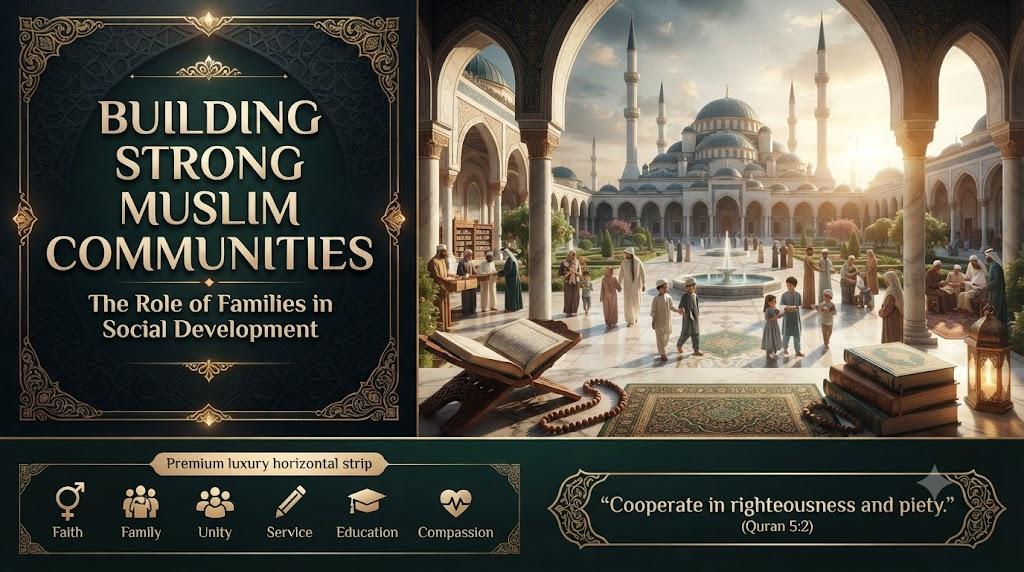
Families serve as fundamental units building—or undermining—broader Muslim communities. Strong families produce individuals capable of contributing positively to society; dysfunctional families generate problems communities must address. Understanding family-community connection helps prioritize investments yielding compound returns across individual, familial, and collective levels.
Socialization occurs primarily within family context. Children learn values, behaviors, social skills, and identity primarily from parents and siblings before schools, peers, or media exert significant influence. Families transmitting Islamic values authentically produce young people grounded in faith, equipped to participate constructively in community life. Conversely, families failing in this task send ill-prepared individuals into community—creating remediation needs that strain collective resources.
Economic productivity stems from family foundation. Well-functioning families produce educated, skilled, emotionally stable workers and entrepreneurs. Dysfunctional backgrounds correlate with unemployment, underperformance, and economic dependency. Investment in family stability (counseling support, parent education, economic safety nets) yields economic returns exceeding costs through enhanced productivity of next generation.
Crime prevention connects to family health. Research consistently shows strong family bonds reduce delinquency, substance abuse, and criminal behavior. Communities with high rates of family breakdown spend enormous resources on policing, incarceration, and rehabilitation—resources available for productive purposes if families function adequately. Islamic emphasis on family preservation serves crime prevention function alongside spiritual purposes.
Elder care traditionally occurred within family context, reducing societal burden. Aging parents living with or supported by adult children avoid institutional care costs while receiving emotionally superior environment. As family structures weaken, elder care becomes public expense and often impersonal experience. Maintaining multigenerational family connections benefits seniors financially, emotionally, and spiritually.
Community volunteerism originates in family habits of service. Children who see parents volunteering, hosting guests, helping neighbors, and participating in mosque activities internalize civic responsibility. Families focused solely on private concerns produce individuals unlikely to contribute to common good. Islamic emphasis on ummah responsibility starts with family-level modeling of concern beyond self-interest.
Interfaith relations develop through family attitudes. Families teaching respect for all people, curiosity about other traditions, and hospitality toward neighbors of different faiths produce adults capable of constructive interfaith engagement. Prejudice often originates in family-of-origin messages; tolerance likewise begins at home. Muslim families modeling Islamic openness toward diversity contribute to pluralistic societies functioning peacefully.
Environmental stewardship habits form in family context. Households practicing conservation (reducing waste, recycling, energy efficiency), enjoying nature together, and discussing environmental responsibility produce environmentally conscious citizens. Islamic environmental ethics (stewardship/khilafah, prohibition of waste/israf) translate into daily practice primarily through family culture.
Political participation patterns trace to family influences. Families discussing current events, voting together, engaging in civic advocacy, and modeling respectful disagreement about politics produce politically engaged citizens. Apathy or extremism often reflects family-of-origin patterns regarding public affairs. Healthy political engagement requires foundation laid in family discussions about community responsibility.
Supporting families strengthens communities through multiple pathways: parent education programs enhance child-rearing skills; economic assistance prevents stress-induced family breakdown; counseling services address problems before escalation; flexible workplace policies accommodate family needs; housing policy enables multigenerational living when desired; transportation infrastructure connects families to resources. Policy decisions affecting families ultimately determine community health.
Mosque programming should intentionally support families, not compete with family time. Family-friendly prayer spaces, childcare during events, activities designed for various age groups, and scheduling that respects family time all make mosques family-strengthening rather than family-competing institutions. Religious centers recognizing family primacy serve communities better than those demanding priority over family obligations.
Community culture should value family investment. Celebrating family achievements, accommodating family needs in organizational settings, and speaking positively about family contributions reinforce social norm supporting family stability. Peer pressure can encourage family commitment when community culture elevates family importance.
Individual families considering their community impact make choices differently than those focused only on private benefit. Questions like “How does this decision affect our children’s future contribution?” or “Does our family life strengthen or weaken our community?” introduce broader perspective into family decisions. This expanded view aligns with Islamic concept of individual actions having social ramifications (amana/trust responsibility).
The virtuous cycle works bidirectionally: strong communities support families through resources, culture, and policies; strong families build communities through producing capable citizens, reducing social problems, and contributing to common good. Investing in either strengthens both. Conversely, neglecting either weakens both. Strategic community development recognizes this interconnection and targets interventions accordingly.
Ultimately, families building strong homes serve Allah through creating environments where faith flourishes, character develops, and members grow to contribute blessings to all creation. This sacred work, though often invisible and undervalued, constitutes foundational community development that all other efforts depend upon.